
- Mt. Kailash Tour
- Kailash Mansarovar Overland Tour
- Kailash Mansarovar Yatra by Helicopter – Complete Spiritual Journey Guide
- Kailash Yatra via Lucknow
- Kailash Mansarovar Tour via Lhasa
- Kailash Lhasa EBC Tour From Beijing
- Kailash Heli Tour via Kerung: Complete Spiritual Journey Guide
- Kailash Tour via Lhasa In Kerung Out
- Lhasa EBC Kailash Tour
- Kailash Heli Tour
- Kailash Mansarovar Yatra from Nepal 2027: Cost & Itinerary
- Kailash Nandi Kora
- Kailash Tour via Humla Simikot – 20 Days
- Mount Kailash Tour: 7 Amazing Experiences in 2027
- Trekking
-
-
- Everest Region
- Luxury Everest Base Camp Trek: 7 Unforgettable Highlights
- Everest Base Camp Trek 2026: Cost, Route, and Complete Guide
- Everest Three Passes Trek 2027: Cost, Route & Itinerary
- Everest Base Camp Short Trek
- Everest Panorama Trek: Amazing 10-Day Cost & Itinerary
- Everest Base Camp Island Peak Trek: Complete 19-Day Guide
- Gokyo Valley Trekking 2027: Easy Guide to Cost & Itinerary
- Mera Peak Climbing 2027: Complete Cost & Itinerary Guide
- Rolwaling Valley Trek: 23-Day Itinerary, Cost, Permits & Difficulty
- Dolpo Region Trek
- Everest Region
-
- Annapurna Region
- Annapurna Base Camp Trekking
- Annapurna Circuit Trek
- Annapurna Base Camp Trek: 7 Amazing Cost & Route Tips
- Mardi Himal Trek: 7 Amazing Highlights & Complete Guide
- Annapurna Alternative Combine Trek: 18 Amazing Days
- Mohare Dada Trek
- Ghorepani Poon Hill Trek: 7 Unforgettable Highlights
- Khopra Ridge Community Trek: 13-Day Ultimate Adventure
- Damodar Kunda Trek: 10-Day Ultimate Sacred Adventure
- Upper Mustang Trek: 10 Amazing Sights : Ultimate Guide
- Jomsom Muktinath Trek: Amazing 12-Day Ultimate Guide
- Ghale Gaun Trek: 7 Amazing Reasons : Ultimate Guide
- Dhampus Sarangkot Trek: 7 Incredible Experiences
- Dhaulagiri Region
- Annapurna Region
-
-
- Tours
-
-
- Day Tours
- Rickshaw–a three-wheeler Tour
- Pharping Dakshinkali Day Tour: 7 Amazing Highlights
- Historical Tour: 7 Amazing Places to Explore
- Kathmandu Temple Tour: 7 Amazing Spiritual Places
- Nagarkot Tour
- Bhaktapur City Tour: 7 Amazing Places to Explore
- Kathmandu City Tour – Complete Heritage & Cultural Experience in Nepal
- Chandragiri Hill: A Scenic Himalayan Escape Near Kathmandu
- Chitlang Hiking
- Shivapuri to Sundarijal Day Hiking
- Kulekhani Dam Day Tour — Complete Travel Guide
- Day Tours
-
- Package Tours
- Mustang Tour on Jeep
- Nepal Tour Package for Nepali: 12 Amazing Destinations to Explore (2026)
- Muktinath Tour: Complete Guide to Nepal’s Sacred Himalayan Pilgrimage
- 3N,4D Kathmandu Pilgrimage Tour
- Nepal Buddhist Pilgrimage Tour: 7 Sacred Sites Not to Miss
- 6D Nepal Pilgrimage Tour: 7 Amazing Sacred Places
- 7 Nights, 8 Days Nepal Tour
- Districts tour of Nepal
- Janakpur Tour Package: Price, Family Tour & Travel Guide from Kathmandu 2026
- Short Hike in Nepal: 7 Best Easy Treks for Beginners
- Package Tours
-
-
- Outbound
-
- Activities
- Climbing
- Bungee Jumping in Nepal
- Heli Skiing Adventure in the Himalayas
- Canoeing in Nepal
- Mountain Flight in Nepal
- Zip Flyer in Pokhara: The Ultimate Adventure Experience
- Paragliding in Pokhara: 7 Amazing Reasons to Experience Nepal’s Best Adventure
- Kathmandu Cycling Tour: 9 Amazing Adventures
- Rafting
- Rock Climbing
- Company
- Travel Info
- Travel Insurance
- Recommended Medical Kit
- Nepal Visa Information
- Flight delays and cancellation in Nepal
- Electricity in Nepal: Rates, Bill Check, Calculator and NEA Services
- Trekking Equipment Checklist: 40 Essential Items
- Best Kailash season in Tibet
- Best Trekking season in Nepal
- Trekking in Nepal 2027: 15 Best Himalayan Adventures
- Blogs
- Contact


WhatsApp
+977-9851035239

Email Us
[email protected]
Ghorepani Poon Hill Trek: 7 Unforgettable Highlights


Trip Duration
10 Days
Trip Difficulty
Moderate
Max. Altitude
3,210m. / 10,531ft.
Activity
Trekking, Hiking & Sightseeing
Destination
Nepal
Group Size
2-15 Pax
Accommodation
3-4 star hotel in kathmandu, Normal hotel in TrekkingHighlights of Ghorepani Poon Hill Trek: 7 Unforgettable Highlights
- Witness a magnificent Himalayan sunrise from Poon Hill at 3,210 meters.
- Enjoy panoramic views of Annapurna, Dhaulagiri, Machhapuchhre, Nilgiri, and Hiunchuli.
- Walk through colorful rhododendron forests, waterfalls, and terraced farmlands.
- Stay in welcoming mountain villages such as Tikhedhunga, Ghorepani, Tadapani, and Ghandruk.
- Discover traditional Gurung culture and visit the Gurung Museum in Ghandruk.
- Experience the scenic Ghorepani Poon Hill Ghandruk Trek circuit without technical climbing.
- Enjoy comfortable teahouse accommodation and warm local hospitality.
- Explore cultural heritage sites in Kathmandu and the natural beauty of Pokhara.
Price starts
US$ 600
We offer group discounts
-
1 -
4 person
US$ 700
-
5 -
10 person
US$ 600
-
11 over
9999
US$ 550
Total Cost:
US$ 700

Need Help?
Ask to Travel Expert
Trip Overview of Ghorepani Poon Hill Trek: 7 Unforgettable Highlights
The Ghorepani Poon Hill Trek is one of Nepal’s most rewarding short Himalayan journeys. Beginning near Pokhara, the trail leads through terraced hills, rhododendron forests, and welcoming mountain villages before reaching the celebrated Poon Hill viewpoint. From the summit, trekkers can watch the first sunlight spread across the Annapurna and Dhaulagiri ranges.
This journey is suitable for travellers who want impressive mountain scenery without committing to a long or extremely high-altitude expedition. The Ghorepani Poon Hill Trek combines manageable walking days, comfortable teahouses, cultural encounters, and a spectacular sunrise experience. Although the route includes many stone steps and steady climbs, most reasonably fit beginners can complete it with sensible preparation.
The route can be arranged in several ways. Some travellers choose a compact three- or four-day programme from Pokhara, while others prefer the Ghorepani Poon Hill Trek 6 Days plan for a more relaxed pace. Adding Ghandruk creates a scenic circuit rather than returning along the same trail. This guide explains the highlights, route, distance, altitude, seasons, estimated cost, permits, and practical preparation required for the Ghorepani Poon Hill Trek.
Why Choose the Ghorepani Poon Hill Trek?
The Ghorepani Poon Hill Trek offers an excellent balance between accessibility and genuine Himalayan adventure. It does not reach the extreme elevations of Everest Base Camp or the Annapurna Circuit, yet it provides close views of several famous peaks. Travellers can spend each night in a mountain settlement instead of camping, making the experience convenient for first-time visitors to Nepal.
Another advantage is flexibility. The Ghorepani Poon Hill Trek is easily accessible from Pokhara and can fit into a short Nepal holiday. A standard route passes through Tikhedhunga or Ulleri, Ghorepani, Poon Hill, Tadapani, and Ghandruk. Road access allows the starting and finishing points to change according to available time, trail conditions, and the traveller’s fitness.
The Nepal Tourism Board describes the route as a popular short trek suitable for beginners and families. The Ghorepani Poon Hill Trek is therefore a practical choice for couples, groups, families with active older children, and travelers attempting their first multiday trek.
7 Unforgettable Ghorepani Poon Hill Trek Highlights
Spectacular Sunrise from Poon Hill
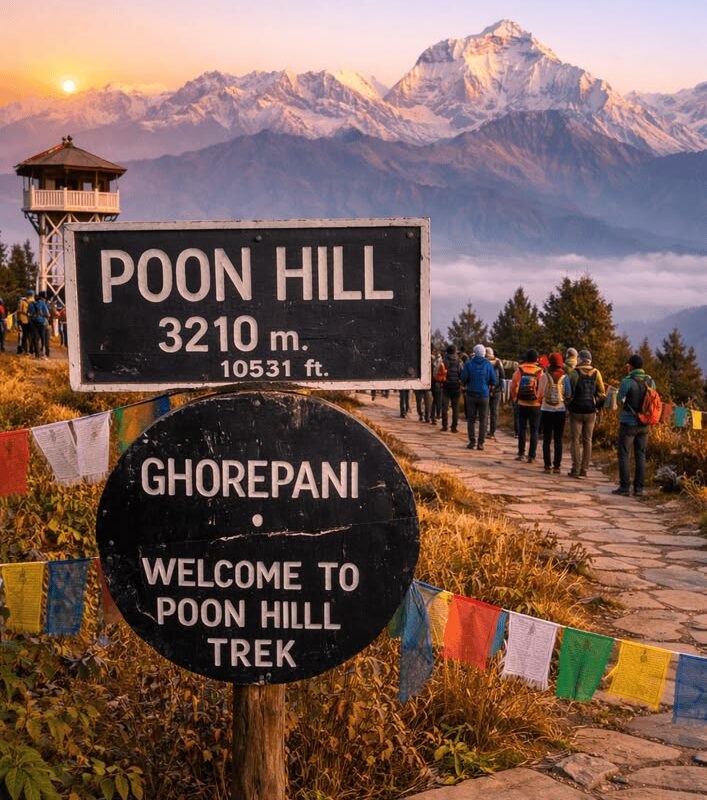
The sunrise walk is the defining experience of the Ghorepani Poon Hill Trek. Trekkers usually leave Ghorepani before dawn and climb uphill with headlamps. As daylight appears, the snowy skyline gradually changes from grey to pink, orange, and gold.
Poon Hill stands at approximately 3,210 meters and provides a wide panorama without requiring technical climbing. On a clear morning, the viewpoint reveals Dhaulagiri, Annapurna South, Annapurna I, Machhapuchhre, Hiunchuli, Nilgiri, and neighboring peaks. The Ghorepani Poon Hill Sunrise Trek is especially attractive to photographers because the light, clouds, and mountain colors change within minutes.
The Ghorepani Poon Hill Trek rewards an early start, but visibility always depends on the weather. Travellers should treat a clear sunrise as a natural experience rather than a guaranteed performance.
Panoramic Annapurna and Dhaulagiri Views
The Ghorepani Poon Hill Trek brings two great Himalayan massifs into one sweeping view. Dhaulagiri rises to the west, while the Annapurna range forms a dramatic line across the north and east. Machhapuchhre, also known as Fishtail Mountain, adds its unmistakable pointed profile to the skyline.
Mountain views are not limited to Poon Hill. Clear sections around Ghorepani, Deurali, Tadapani, and Ghandruk offer changing perspectives throughout the journey. This variety means the trek remains visually interesting even after the sunrise excursion is complete.
Colorful Rhododendron Forests
Large sections of the Ghorepani Poon Hill Trek pass through oak and rhododendron woodland. During spring, red, pink, and white blossoms brighten the slopes and create colorful tunnels above the trail. Moss-covered trunks, ferns, and small streams give the forest a peaceful atmosphere.
The protected landscape forms part of the Annapurna Conservation Area, Nepal’s largest conservation area. Trekkers may hear forest birds and occasionally see langurs or other wildlife, although sightings are never guaranteed. Walking quietly and keeping a respectful distance helps protect the animals and their habitat.
Traditional Ghorepani Village
Ghorepani was historically associated with traders and travelers moving through the hills. Today, the village is a major overnight stop on the Ghorepani Poon Hill Trek. Its blue-roofed lodges, stone lanes, and mountain backdrop create a welcoming place to rest before the early ascent to Poon Hill.
The settlement has teahouses, dining rooms, small shops, and viewpoints. Evenings are usually spent around a warm dining area, sharing stories with other trekkers and preparing clothing for the cold morning walk. Staying in Ghorepani makes the sunrise experience more comfortable because the viewpoint is reached directly from the village.
Gurung Culture in Ghandruk
The Ghorepani Poon Hill Ghandruk Trek extends the journey through Tadapani to one of the Annapurna region’s best-known Gurung villages. Ghandruk features traditional stone houses, narrow pathways, cultivated terraces, and remarkable views of Annapurna South, Hiunchuli, and Machhapuchhre.
Visitors can learn about local customs, architecture, and community life while staying in village lodges. Cultural museums may be open depending on local schedules. Adding Ghandruk also improves the route because trekkers complete a varied circuit instead of simply retracing their steps from Ghorepani.
Welcoming Teahouse Experience
Simple teahouses make the Ghorepani Poon Hill Trek accessible without camping equipment. Most lodges provide twin rooms, blankets, shared or attached bathrooms, and a dining area. Facilities become simpler away from road-connected settlements, but the route is generally comfortable compared with more remote treks.
Menus commonly include dal bhat, noodles, soup, fried rice, potatoes, momos, pasta, eggs, and porridge. Hot drinks are widely available. Eating local meals and purchasing services from community-run lodges helps keep more tourism income within the villages.
A Short and Achievable Himalayan Adventure
The Ghorepani Poon Hill Trek delivers a strong sense of achievement within a relatively short period. The highest viewpoint is moderate by Himalayan trekking standards, and the route does not require mountaineering skills. Trekkers still experience changing landscapes, long staircases, cool mountain mornings, and several days of purposeful walking.
This balance is why the trail works well for travellers who have limited holiday time. With a suitable pace, rest stops, and proper footwear, the Ghorepani Poon Hill Trek can become an enjoyable introduction to trekking in Nepal rather than an exhausting endurance test.
Ghorepani Poon Hill Trek Route
The classic Ghorepani Poon Hill Trek begins after a drive from Pokhara towards Nayapul, Birethanti, Hile, or a nearby road-access point. The exact starting location depends on road conditions and the itinerary selected. From the lower valley, the trail climbs through Tikhedhunga and Ulleri before continuing into forested country towards Ghorepani.
After spending the night in Ghorepani, trekkers make the pre-dawn ascent to Poon Hill and return for breakfast. The route then commonly crosses Deurali and Banthanti before reaching Tadapani. From Tadapani, the path descends through forest to Ghandruk, where trekkers can enjoy another night of mountain views and village culture.
The Ghorepani Poon Hill Ghandruk Trek normally finishes with a descent or short walk to a roadhead for the return drive to Pokhara. Some programs continue through Landruk or Australian Camp, while shorter versions finish directly from Ghandruk. Route construction and seasonal road conditions can change the walking point, so the daily distance should remain flexible.
Understanding the Ghorepani Poon Hill Trekking Map
A useful Ghorepani Poon Hill Trekking Map should show Pokhara, Nayapul, or the selected trailhead, Tikhedhunga, Ulleri, Ghorepani, Poon Hill, Deurali, Tadapani, and Ghandruk. It should also indicate elevation gain, estimated walking time, water points, road connections, and alternative exits.
Digital maps are helpful, but they should not replace local guidance. Paths may be diverted because of maintenance, landslides, new roads, or weather. Carry an offline copy of the Ghorepani Poon Hill Trekking Map, keep your phone charged, and follow marked trails. A licensed guide can confirm the safest current path and adjust the schedule when conditions change.
Ghorepani Poon Hill Trek Distance and Duration
The total Ghorepani Poon Hill Trek distance is not identical for every program. It changes according to the roadhead, overnight stops, side trips, and finishing point. A common loop through Ghorepani, Poon Hill, Tadapani, and Ghandruk covers roughly 40 to 55 kilometers of walking. Routes beginning farther down the valley or continuing beyond Ghandruk can be longer.
Daily walking usually ranges from four to seven hours. The distance on paper may look modest, but steep stone staircases can make a short section feel demanding. Elevation gain, weather, rest stops, and trail congestion also influence the time required. For this reason, walking hours are more useful than kilometers when comparing programs.
Before comparing itineraries for the Ghorepani Poon Hill Trek, check where the walking actually starts and finishes. Two programs with the same number of days may include very different amounts of road travel and trail distance.
Ghorepani Poon Hill Trek 6 Days
The Ghorepani Poon Hill Trek 6 Days option gives travelers a comfortable balance of trekking and cultural exploration. A typical program uses one day to reach the trail, walks gradually through Ulleri and Ghorepani, includes the Poon Hill sunrise, continues to Tadapani and Ghandruk, and then returns to Pokhara.
This duration is suitable for beginners because the walking is divided into manageable stages. It also provides more time for photography, village exploration, and rest than a rushed itinerary. A Ghorepani Poon Hill Trek 6-day plan may vary by one day depending on whether arrival in Pokhara, local transport, or an additional village night is counted.
Shorter and Longer Options
A three- or four-day Ghorepani Poon Hill Trek is possible when travelers begin close to the main trail and maintain a faster pace. These programs can work for experienced hikers but may feel hurried for beginners. Long uphill days and the early sunrise walk leave limited recovery time.
Five- or six-day itineraries are generally more relaxed. Longer programs can add Ghandruk, Landruk, Jhinu Danda, or Australian Camp. The best schedule is not always the shortest; it is the one that matches fitness, interests, and available time without turning every day into a race.
Ghorepani Poon Hill Trek Altitude and Difficulty
The highest point of the Ghorepani Poon Hill Trek is Poon Hill at approximately 3,210 meters. Ghorepani lies below the viewpoint at around 2,850 meters, while many other overnight locations are lower. These elevations are moderate compared with Nepal’s high passes and base camps, but the effects of altitude can still differ from person to person.
The Ghorepani Poon Hill Trek is normally graded easy to moderate. No ropes, crampons, or climbing experience are required on the standard trail. Its main physical challenges are repeated ascents and descents, uneven stone paths, and the famous staircase towards Ulleri. Rain, snow, or ice can increase the difficulty considerably.
Fitness and Walking Preparation
Travellers preparing for the Ghorepani Poon Hill Trek should practise walking uphill and downhill several weeks before departure. Regular cardio exercise, stair climbing, and weekend hikes help strengthen the legs and improve stamina. Training with the shoes and daypack intended for Nepal can identify discomfort before the journey begins.
Walking slowly is more effective than starting fast and becoming exhausted. Short breaks, steady hydration, and a comfortable rhythm make the climbs manageable. Trekking poles can reduce pressure on the knees during long descents, particularly between Tadapani, Ghandruk, and the lower roadhead.
Altitude Awareness
Serious altitude problems are less common on the Ghorepani Poon Hill Trek than on higher routes, but symptoms should never be ignored. Headache, nausea, dizziness, unusual fatigue, or disturbed coordination require attention. Rest, hydration, and honest communication with the guide are essential.
Travellers should not force themselves higher when symptoms worsen. A guide may recommend resting or descending. Travel insurance should cover trekking at the maximum planned elevation and include emergency treatment and evacuation where appropriate.
Best Time for the Ghorepani Poon Hill Trek
The Ghorepani Poon Hill Trek can be completed during much of the year, but spring and autumn generally provide the most favorable combination of visibility, temperature, and trail conditions. Each season creates a different experience, so the right choice depends on whether the priority is clear mountains, flowers, fewer visitors, or winter scenery.
Spring: March to May
Spring is famous for flowering rhododendrons. Forest sections become colorful, days are generally mild, and mountain mornings can be clear. March may remain cool at Ghorepani, while April is often popular for blossoms. Haze and afternoon clouds can develop later in the season, making an early start important.
The Ghorepani Poon Hill Trek is busy during peak spring weeks. Reserving rooms through a trekking company can reduce uncertainty in popular villages. Trekkers should still carry a waterproof layer because mountain weather can change quickly.
Autumn: September to November
Autumn is another leading season for the Ghorepani Poon Hill Trek. After the summer monsoon, the landscape is green, and the atmosphere often becomes clearer. October and November are especially popular for stable walking conditions and wide Himalayan views.
Popular lodges and viewpoints can become crowded. Starting early, keeping a flexible pace and respecting other visitors improves the experience. Night-time temperatures fall as November progresses, so warm layers become increasingly important.
Winter: December to February
Winter can bring crisp visibility, quieter trails, and cold nights. The Ghorepani Poon Hill Sunrise Trek may be particularly beautiful after fresh snowfall, but snow or ice can make steps slippery. Temperatures before dawn at Poon Hill may fall below freezing.
Winter trekkers need a warm sleeping bag, insulated jacket, gloves, and suitable footwear. Some lodges may operate with reduced services. The itinerary should allow flexibility if heavy snow affects the trail or road access.
Monsoon: June to August
The summer monsoon brings lush forests, dramatic clouds, rain, and fewer trekkers. However, leeches, muddy paths, poor visibility, and transport delays can affect the Ghorepani Poon Hill Trek. Landslides may disrupt roads or trails after intense rainfall.
Anyone considering a monsoon departure should use waterproof bags, quick-drying clothing, and reliable rain protection. Check the official weather forecast before travel and follow local advice. A flexible schedule is especially important during this season.
Ghorepani Poon Hill Trek Cost
The Ghorepani Poon Hill Trek cost depends on the duration, group size, accommodation standard, transportation, and services included. A private trip generally costs more per person than a group departure. Starting from Kathmandu also adds flights or road transport and extra hotel nights, while a package beginning in Pokhara is usually less expensive.
The main expenses include permits, guide and porter wages, transport, teahouse rooms, meals, drinking water, hot showers, charging, Wi-Fi where available, and personal snacks. Prices tend to increase with elevation because supplies require more transport. Seasonal demand and exchange-rate changes may also affect package rates.
What a Trek Package May Include
A well-organized Ghorepani Poon Hill Trek package may include ground transportation, licensed guide service, porter support according to the agreed ratio, conservation-area entry, TIMS arrangements, accommodation, selected meals, and basic first-aid support. Inclusions differ between companies, so travelers should read the written quotation carefully.
International flights, Nepal visa fees, travel insurance, alcoholic drinks, bottled beverages, hot showers, battery charging, tips, and personal purchases are commonly excluded. Clarifying these details prevents confusion during the trek. The lowest price is not necessarily the best value if important services are missing.
Planning a Realistic Budget
When comparing the Ghorepani Poon Hill Trek cost, ask whether the advertised amount covers the complete route or only trekking days. Confirm the room type, meal plan, private or shared transport, guide qualifications, porter allowance, and emergency procedure. Keep a small cash reserve because card payment and ATMs are not dependable in mountain villages.
Package prices change, so a fixed online figure can become outdated. Request a current quotation based on travel dates and group size. A transparent proposal should state exactly what is included, what is excluded, and which optional expenses may arise.
Permits and Guide Arrangements
The Ghorepani Poon Hill Trek enters the Annapurna Conservation Area. Travellers should obtain the required conservation-area entry permit before beginning. The official NTNC permit portal provides current application information, while fees and procedures should be reconfirmed before departure because regulations can change.
Trekkers may also need a Trekkers’ Information Management System card under the rules applying to their route and travel arrangement. Review the current TIMS guidance and arrange documents through an authorized trekking company when required. Carry the original passport and copies of relevant permits for checkpoints.
A licensed guide adds route knowledge, cultural interpretation, and support when weather, illness, or transport changes the plan. For the Ghorepani Poon Hill Trek, a guide can also help coordinate rooms during busy seasons and communicate with local lodge owners. Porters are optional for many travellers but make steep sections more comfortable when baggage is heavy.
Permit checks may occur along the Ghorepani Poon Hill Trek, so documents should remain accessible and protected from rain. Never rely only on a photograph stored on a phone with limited battery power.
Accommodation and Meals
Accommodation on the Ghorepani Poon Hill Trek is mainly provided by teahouses. Rooms are simple and usually contain two beds, mattresses, pillows, and blankets. Attached bathrooms are available in some lodges, while other properties use shared facilities. Heating is normally limited to the dining room, and bedrooms can become cold at night.
Electricity, charging, hot showers, and Wi-Fi are available in many settlements but may involve an additional fee. Service can be interrupted by weather or power problems. Carrying a power bank, headlamp, and small supply of tissues makes the journey easier.
Food menus are varied for a short trekking route. Dal bhat is popular because it provides rice, lentils, vegetables, and useful energy. Other choices may include soup, noodles, pasta, fried rice, potatoes, pancakes, and eggs. During the Ghorepani Poon Hill Trek, choosing freshly prepared food and drinking treated or safely boiled water reduces avoidable health problems.
Because the Ghorepani Poon Hill Trek follows an established teahouse route, trekkers do not need to carry food for every day. However, a few familiar snacks can be useful between villages or during the early sunrise climb.
Packing for the Ghorepani Poon Hill Trek
Packing should reflect the season rather than the route’s moderate altitude alone. Conditions can move from warm sunshine in lower villages to freezing wind at Poon Hill. The layering system is more useful than one heavy item because clothing can be added or removed as temperatures change.
Essential items for the Ghorepani Poon Hill Trek include:
- Broken-in trekking boots or supportive walking shoes
- Moisture-wicking base layers and quick-drying shirts
- Fleece or warm mid-layer
- Insulated jacket for mornings and evenings
- Waterproof jacket and rain cover
- Comfortable trekking trousers
- Warm hat, sun hat, and gloves
- Sunglasses and high-SPF sunscreen
- Refillable water bottle and purification method
- Headlamp for the Poon Hill sunrise walk
- Personal medication and basic first-aid items
- Trekking poles for steps and descents
- Power bank and waterproof document pouch
Avoid overpacking. A lighter bag improves balance and reduces fatigue on the stone staircases. If using a porter, follow the agreed weight limit and keep valuables, permits, water, medication, and a waterproof layer in the daypack.
Responsible Trekking in the Annapurna Region
The popularity of the Ghorepani Poon Hill Trek creates both economic opportunities and environmental pressure. Travellers can reduce their impact by carrying a refillable bottle, avoiding unnecessary plastic, taking rubbish to an appropriate collection point, and using water carefully. Do not leave tissues, food wrappers, or batteries on the trail.
Respect village life by asking permission before photographing people, dressing appropriately, and keeping noise low. Walk around religious structures in the locally accepted direction and follow instructions at temples or community sites. Purchasing local food, crafts, and accommodation supports the households that maintain the trekking experience.
Forest fires are a serious risk during dry periods. Smoking, open flames, and careless disposal of matches should be avoided. Remain on established paths, do not pick wildflowers, and never feed wildlife. Responsible behavior helps preserve the Ghorepani Poon Hill Trek for residents and future visitors.
Who Should Choose This Trek?
The Ghorepani Poon Hill Trek is well suited to first-time trekkers, photographers, couples, families with active older children, and travelers who want a short extension from Pokhara. It is also attractive to experienced hikers seeking a scenic warm-up before a longer Annapurna journey.
However, “short” does not mean effortless. People with serious knee, heart, lung, or mobility concerns should seek professional medical advice before booking. The numerous steps and daily elevation changes can be demanding. Choosing a slower itinerary, using trekking poles, and hiring a porter may make the route more comfortable.
The Ghorepani Poon Hill Ghandruk Trek is particularly suitable for travelers interested in both landscape and culture. Those focused mainly on the viewpoint may select a shorter return route, while travelers who enjoy villages should include Tadapani and Ghandruk.
Preparing for a Safe and Enjoyable Journey
Begin physical preparation at least four to six weeks before the Ghorepani Poon Hill Trek. Walk regularly, practice stairs, and include longer hikes on consecutive days. Strengthening the legs and core improves stability, while stretching and recovery reduce the chance of arriving tired before the trek begins.
Choose travel insurance that covers the planned activity and elevation. Share medical conditions and dietary requirements with the trekking company before departure. Keep copies of the passport, insurance policy, emergency contacts, and permits in both digital and printed form.
During the trek, drink regularly, eat enough, and protect yourself from sun exposure. Start early when possible because morning weather is often clearer. The guide should have the authority to adjust the Ghorepani Poon Hill Trek schedule if rain, snow, landslides, illness, or road conditions create a safety concern.
Conclusion
The Ghorepani Poon Hill Trek brings together the qualities that make trekking in Nepal memorable: Himalayan panoramas, forest trails, stone villages, welcoming lodges, and a sunrise that transforms the entire mountain skyline. Its moderate altitude and flexible duration make it approachable, while the climbs and long staircases provide a satisfying physical challenge.
Whether you choose a short program, the Ghorepani Poon Hill Trek 6 Days plan, or a complete circuit through Ghandruk, the journey can be adjusted to your pace and interests. A clear Ghorepani Poon Hill trekking map, suitable clothing, realistic budgeting, and current permit information will help you prepare confidently.
For travelers who want a compact Himalayan adventure close to Pokhara, the Ghorepani Poon Hill Trek remains an outstanding choice. Walk patiently, respect local communities, and leave space in the schedule for changing mountain conditions. The result is far more than a sunrise viewpoint—it is a rewarding journey through the natural and cultural heart of the Annapurna region.
Detail Itinerary of Ghorepani Poon Hill Trek: 7 Unforgettable Highlights
Day 01: Arrival in Kathmandu
Your wonderful journey to the amazing Himalayas starts from your flight to Kathmandu. On your arrival, our company representatives will greet you at the Tribhuwan International Airport and escort you to the hotel for check-in and overnight stay. You will have a rest at the hotel. Overnight at Hotel.
Day 02: Sightseeing of Kathmandu and Bhaktapur city
Before beginning the Ghorepani Poon Hill Trek, enjoy a guided tour of four UNESCO-listed heritage sites: Kathmandu Durbar Square, Pashupatinath Temple, Boudhanath Stupa, and Swayambhunath, also known as the Monkey Temple. Discover ancient palaces, sacred Hindu traditions, Buddhist culture, and impressive Newari architecture.

Accommodation
Overnight at a hotel in Kathmandu.Day 03: Drive from Kathmandu to Pokhara & Evening Sightseeing
We take a ride on a car or tourist bus to Pokhara, all the way through scenic mountain terrain; its fame rests on the natural beauty of its lakeside location and its proximity to the mountains. After taking a bit of rest, you can have evening sightseeing in Pokhara Valley. Stay overnight at the hotel.
Day 04: Pokhara-drive to Nayapul (1 hours) and trek to Tikedhunga (4 hrs)
After breakfast, drive to Nayapul and begin the Ghorepani Poon Hill Trek towards Tikhedhunga. Walk through subtropical forests, terraced farmlands, green hills, and waterfalls before crossing a suspension bridge. After approximately four hours of trekking, reach Tikhedhunga.

Activity & Duration
Walking time: Approximately 4 hours
Accommodation
Guesthouse in TikhedhungaDay 05: Tikedhunga trek to Ghorepani (7 hours), overnight in teahouse
After breakfast, continue uphill on the Ghorepani Poon Hill Trek through forests, stone steps, and mountain settlements. Ghorepani was once a watering stop for horses travelling along the historic trade route. Today, it is a popular trekking village offering local shops, comfortable teahouses, and beautiful views of Annapurna South and Nilgiri.
Accommodation
Teahouse in GhorepaniDay 06: Ghorepani to Poon Hill (View point) to Tadapani(6hrs)
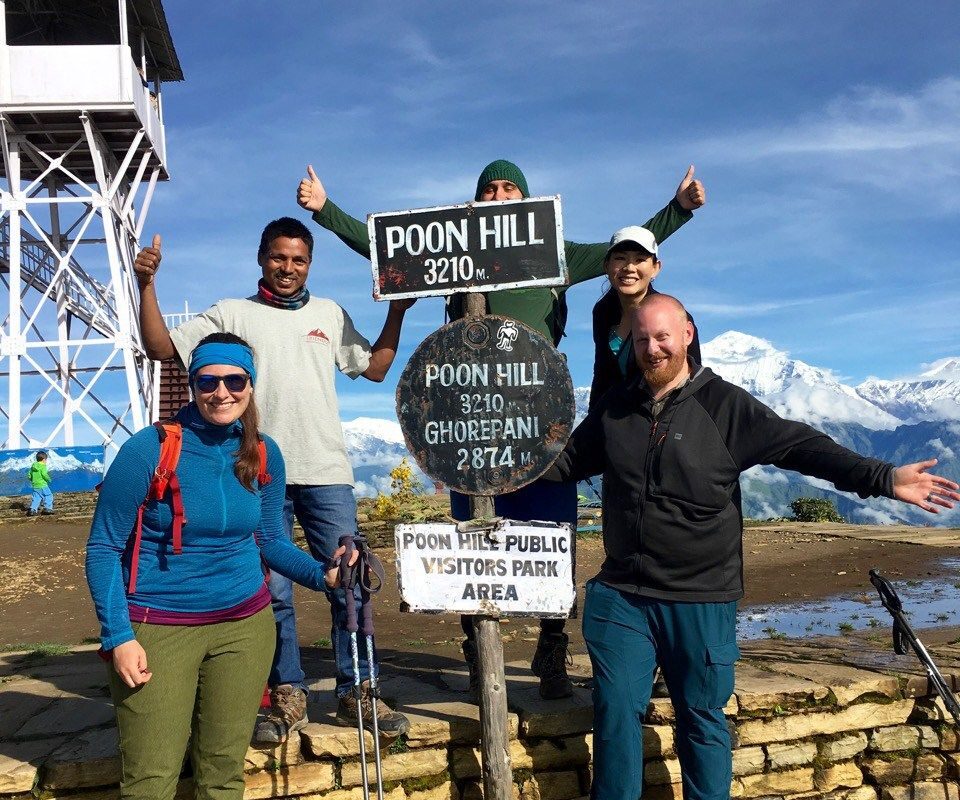
Today is the main highlight of the Ghorepani Poon Hill Trek. Begin before sunrise and climb to Poon Hill at 3,210 meters for panoramic views of the Annapurna and Dhaulagiri ranges. After enjoying the sunrise and taking photographs, return to Ghorepani for breakfast. Continue through rhododendron forests and waterfalls to Tadapani.
Highest Altitude
3210m. ()
Accommodation
Teahouse in TadapaniDay 07: Tadapani to Ghandruk (1940m)
Continue the Ghorepani Poon Hill Ghandruk Trek with a steep descent through dense rhododendron forests, which become colorful with blossoms during spring. Arrive at the traditional Gurung village of Ghandruk and explore its stone houses, local culture, and Gurung Museum.
Accommodation
Teahouse in GhandrukDay 08: Ghandruk to Birethanti – Naya Pul; then drive to Pokhara
The final walking day of the Ghorepani Poon Hill Trek descends from Ghandruk through stone staircases, terraced fields, and waterfalls to Birethanti. Continue to Nayapul, where the trek ends, and drive back to Pokhara.
Accommodation
Hotel in PokharaDay 09: Drive/fly back to Kathmandu
After breakfast, enjoy free time for sightseeing or shopping in Pokhara before returning to Kathmandu by flight or road. Upon arrival, transfer to your hotel and relax. In the evening, celebrate the successful completion of the Ghorepani Poon Hill Trek with a farewell dinner.
Accommodation
Hotel in KathmanduDay 10: Transfer to the airport for the final departure
Nearly 2 hours before your scheduled flight, our company representative will take you to the airport. We are sure you will be back to your home taking amazing experiences in Nepal. We hope you enjoyed trekking and want to be somewhere in the Himalayas again

- This itinerary is a recommended program and may change because of weather, trail conditions, road access, or safety concerns.
- Walking times, distances, and altitudes are approximate and may vary according to the group’s pace.
- Sunrise and mountain views from Poon Hill depend on weather and visibility.
- Starting and finishing points may change according to current road conditions.
- Accommodation is arranged in hotels and local teahouses, where facilities may vary.
- Travellers must carry the required permits and suitable travel insurance.
- The guide may adjust the Ghorepani Poon Hill Trek itinerary when necessary for the group’s safety and comfort.
Includes and Excludes
What is included?
- Airport pickups and drops in a private vehicle
- Hotel accommodation in Kathmandu with Bed and breakfast
- Teahouse accommodation during the trek
- All meals (breakfast, lunch and dinner) during the trek
- Welcome and farewell dinners
- All ground transportation on a comfortable private vehicle as per the itinerary
- An experienced, English-speaking and government-licensed holder Guide and Porter service (2 trekkers: 1 porter)
- Staff costs including their salary, insurance, equipment, domestic airfare, food and accommodation
- Down jacket
- Medical kit (carried by your trek leader)
- All government and local taxes
What is excluded?
- Nepalese visa fee
- Excess baggage charge(s)
- Extra night accommodation in Kathmandu because of early arrival, late departure, early
- Return from mountain (due to any reason) than the scheduled itinerary
- Emergency expenses like rescues, emergency medical treatment.
- Personal insurance charges.
- International flights
- Travel and rescue insurance
- Personal expenses (phone calls, laundry, bar bills, battery recharge, extra porters, bottle or boiled water, shower, etc.)
- Tips for guide(s), porter(s) and driver(s)
Trip Information
| Trip Information | Details |
|---|---|
| Trip name | Ghorepani Poon Hill Trek |
| Trekking region | Annapurna Region, Nepal |
| Trekking duration | 6 days |
| Highest altitude | Poon Hill – 3,210 metres |
| Trek difficulty | Easy to moderate |
| Approximate distance | 40–55 kilometres |
| Daily walking time | Approkilometers–7 hours |
| Trek starting point | Nayapul or a nearby road-access point |
| Trek ending point | Nayapul |
| Main destinations | Tikhedhunga, Ghorepani, Poon Hill, Tadapani, and Ghandruk |
| Best seasons | Spring and autumn |
| Accommodation | Hotels in the cities and teahouses during the trek |
| Meals | According to the selected package |
| Transportation | Road transfers with an optional Pokhara–Kathmandu flight |
| Required permits | ACAP and TIMS according to current regulations |
| Trek type | Guided teahouse trek |
| Suitable for | Beginners, families, couples, and short-holiday travellers |
| Major attractions | Himalayan sunrise, mountain views, rhododendron forests, and Gurung culture |
Frequently Asked Questions
Is the Ghorepani Poon Hill Trek suitable for beginners?
Yes. The Ghorepani Poon Hill Trek is suitable for beginners with reasonable fitness. The route does not require technical climbing, but trekkers should prepare for steep hills, uneven trails, and numerous stone steps.
How difficult is the Ghorepani Poon Hill Trek?
The trek is generally graded easy to moderate. Most walking days last approximately four to seven hours. The long ascent towards Ulleri and repeated downhill sections can be physically demanding.
How many days are required for the Ghorepani Poon Hill Trek?
The trekking route can be completed in three to six days, depending on the starting point and places included. The Ghorepani Poon Hill Trek 6 Days program provides a more comfortable pace and sufficient time to visit Ghandruk.
What is the highest altitude of the Ghorepani Poon Hill Trek?
Poon Hill is the highest point of the Ghorepani Poon Hill Trek at approximately 3,210 meters. The viewpoint is reached from Ghorepani during an early-morning hike.
What is the total Ghorepani Poon Hill Trek distance?
The total walking distance is generally between 40 and 55 kilometers. The exact distance varies according to the road-access point, overnight stops, and whether Ghandruk or other nearby villages are included.
What is the best time for the Ghorepani Poon Hill Trek?
Spring and autumn are considered the best seasons. Spring offers colorful rhododendron forests, while autumn generally provides clear weather and excellent mountain views. Winter is possible with suitable warm clothing.
What can I expect during the Ghorepani Poon Hill Sunrise Trek?
The Ghorepani Poon Hill Sunrise Trek includes an early-morning climb from Ghorepani to Poon Hill. On a clear day, trekkers can watch the sunrise over the Annapurna and Dhaulagiri ranges. Mountain visibility depends entirely on the weather.
Which mountains are visible during the Ghorepani Poon Hill Trek?
Trekkers may see Annapurna South, Annapurna I, Dhaulagiri, Machhapuchhre, Hiunchuli, Nilgiri, and several surrounding peaks. Poon Hill, Tadapani, Ghorepani, and Ghandruk provide some of the best viewpoints.
Why choose the Ghorepani Poon Hill Ghandruk Trek?
The Ghorepani Poon Hill Ghandruk Trek combines Himalayan scenery with Gurung culture. It creates a varied circuit through Ghorepani, Poon Hill, Tadapani, and Ghandruk instead of returning along the same trail.
Do I need a Ghorepani Poon Hill Trekking Map?
A Ghorepani Poon Hill Trekking Map is useful for understanding the route, elevations, and overnight stops. Carry an offline map, but do not rely on it alone because trail access and road conditions can change.
Which permits are required for the Ghorepani Poon Hill Trek?
Trekkers generally require an Annapurna Conservation Area entry permit and must follow current TIMS requirements. Permit and guide regulations can change, so confirm the latest rules with an authorized trekking company before departure.
What accommodation is available during the Ghorepani Poon Hill Trek?
Accommodation is provided in local teahouses. Rooms are usually simple and include twin beds, blankets, and shared or attached bathrooms. Charging, hot showers, and Wi-Fi may be available for an additional fee.
Is the Ghorepani Poon Hill Trek suitable for children?
Active older children with previous hiking experience can complete the trek with a comfortable itinerary. Parents should consider the stone staircases, changing weather, and early-morning Poon Hill climb before booking.
What should I pack for the Ghorepani Poon Hill Trek?
Pack comfortable trekking footwear, warm layers, waterproof clothing, gloves, a hat, sunscreen, sunglasses, a headlamp, trekking poles, and a refillable water bottle. The exact packing list should match the season.
Is travel insurance necessary for the Ghorepani Poon Hill Trek?
Travel insurance is strongly recommended. The policy should cover trekking up to at least 3,210 metres, medical treatment, trip interruption and emergency evacuation.
Trip Reviews
Price starts
US$ 600
Need Help?
Ask to Travel Expert