
- Mt. Kailash Tour
- Kailash Mansarovar Overland Tour
- Kailash Mansarovar Yatra by Helicopter – Complete Spiritual Journey Guide
- Kailash Yatra via Lucknow
- Kailash Mansarovar Tour via Lhasa
- Kailash Lhasa EBC Tour From Beijing
- Kailash Heli Tour via Kerung: Complete Spiritual Journey Guide
- Kailash Tour via Lhasa In Kerung Out
- Lhasa EBC Kailash Tour
- Kailash Heli Tour
- Kailash Mansarovar Yatra from Nepal 2027: Cost & Itinerary
- Kailash Nandi Kora
- Kailash Tour via Humla Simikot – 20 Days
- Mount Kailash Tour: 7 Amazing Experiences in 2027
- Trekking
-
-
- Everest Region
- Luxury Everest Base Camp Trek: 7 Unforgettable Highlights
- Everest Base Camp Trek 2026: Cost, Route, and Complete Guide
- Everest Three Passes Trek 2027: Cost, Route & Itinerary
- Everest Base Camp Short Trek
- Everest Panorama Trek: Amazing 10-Day Cost & Itinerary
- Everest Base Camp Island Peak Trek: Complete 19-Day Guide
- Gokyo Valley Trekking 2027: Easy Guide to Cost & Itinerary
- Mera Peak Climbing 2027: Complete Cost & Itinerary Guide
- Rolwaling Valley Trek: 23-Day Itinerary, Cost, Permits & Difficulty
- Dolpo Region Trek
- Everest Region
-
- Annapurna Region
- Annapurna Base Camp Trekking
- Annapurna Circuit Trek
- Annapurna Base Camp Trek: 7 Amazing Cost & Route Tips
- Mardi Himal Trek: 7 Amazing Highlights & Complete Guide
- Annapurna Alternative Combine Trek: 18 Amazing Days
- Mohare Dada Trek
- Ghorepani Poon Hill Trek: 7 Unforgettable Highlights
- Khopra Ridge Community Trek: 13-Day Ultimate Adventure
- Damodar Kunda Trek: 10-Day Ultimate Sacred Adventure
- Upper Mustang Trek: 10 Amazing Sights : Ultimate Guide
- Jomsom Muktinath Trek: Amazing 12-Day Ultimate Guide
- Ghale Gaun Trek: 7 Amazing Reasons : Ultimate Guide
- Dhampus Sarangkot Trek: 7 Incredible Experiences
- Dhaulagiri Region
- Annapurna Region
-
-
- Tours
-
-
- Day Tours
- Rickshaw–a three-wheeler Tour
- Pharping Dakshinkali Day Tour: 7 Amazing Highlights
- Historical Tour: 7 Amazing Places to Explore
- Kathmandu Temple Tour: 7 Amazing Spiritual Places
- Nagarkot Tour
- Bhaktapur City Tour: 7 Amazing Places to Explore
- Kathmandu City Tour – Complete Heritage & Cultural Experience in Nepal
- Chandragiri Hill: A Scenic Himalayan Escape Near Kathmandu
- Chitlang Hiking
- Shivapuri to Sundarijal Day Hiking
- Kulekhani Dam Day Tour — Complete Travel Guide
- Day Tours
-
- Package Tours
- Mustang Tour on Jeep
- Nepal Tour Package for Nepali: 12 Amazing Destinations to Explore (2026)
- Muktinath Tour: Complete Guide to Nepal’s Sacred Himalayan Pilgrimage
- 3N,4D Kathmandu Pilgrimage Tour
- Nepal Buddhist Pilgrimage Tour: 7 Sacred Sites Not to Miss
- 6D Nepal Pilgrimage Tour: 7 Amazing Sacred Places
- 7 Nights, 8 Days Nepal Tour
- Districts tour of Nepal
- Janakpur Tour Package: Price, Family Tour & Travel Guide from Kathmandu 2026
- Short Hike in Nepal: 7 Best Easy Treks for Beginners
- Package Tours
-
-
- Outbound
-
- Activities
- Climbing
- Bungee Jumping in Nepal
- Heli Skiing Adventure in the Himalayas
- Canoeing in Nepal
- Mountain Flight in Nepal
- Zip Flyer in Pokhara: The Ultimate Adventure Experience
- Paragliding in Pokhara: 7 Amazing Reasons to Experience Nepal’s Best Adventure
- Kathmandu Cycling Tour: 9 Amazing Adventures
- Rafting
- Rock Climbing
- Company
- Travel Info
- Travel Insurance
- Recommended Medical Kit
- Nepal Visa Information
- Flight delays and cancellation in Nepal
- Electricity in Nepal: Rates, Bill Check, Calculator and NEA Services
- Trekking Equipment Checklist: 40 Essential Items
- Best Kailash season in Tibet
- Best Trekking season in Nepal
- Trekking in Nepal 2027: 15 Best Himalayan Adventures
- Blogs
- Contact


WhatsApp
+977-9851035239

Email Us
[email protected]
Everest Three Passes Trek 2027: Cost, Route & Itinerary



Trip Duration
20 Days
Trip Difficulty
Difficult
Max. Altitude
5,550m. / 18,209ft.
Activity
Trekking, Hiking & Sightseeing
Destination
Nepal
Group Size
2-20
Accommodation
3-4 star hotel in kathmandu, Normal hotel in Trekking
Meals
Listed in ItineraryHighlights of Everest Three Passes Trek 2027: Cost, Route & Itinerary
- Cross Renjo La, Cho La, and Kongma La passes
- Reach Everest Base Camp at 5,364 meters
- Enjoy sunrise views from Kala Patthar
- Explore the turquoise Gokyo Lakes
- Walk beside the Ngozumpa and Khumbu glaciers
- See Everest, Lhotse, Makalu, Cho Oyu, and Ama Dablam
- Discover Namche Bazaar and remote Sherpa villages
- Experience Sherpa culture, monasteries, and mountain hospitality
- Trek through UNESCO-listed Sagarmatha National Park
- Complete one of Nepal’s most challenging Himalayan circuits
Price starts
US$ 1400
We offer group discounts
-
1 -
4 person
US$ 1600
-
5 -
10 person
US$ 1400
-
11 over
9999
US$ 1350
Total Cost:
US$ 1600
Need Help?
Ask to Travel Expert
Trip Overview of Everest Three Passes Trek 2027: Cost, Route & Itinerary
The Everest Three Passes Trekking route is one of Nepal’s most complete and demanding teahouse adventures. Instead of following the standard trail to Everest Base Camp and returning the same way, this journey crosses three major Himalayan passes: Renjo La, Cho La, and Kongma La.
Along the way, trekkers explore Namche Bazaar, the Gokyo Lakes, Ngozumpa Glacier, Everest Base Camp, Kala Patthar, and remote Sherpa settlements surrounded by some of the world’s highest mountains.
A well-designed 20-day program gives trekkers time to acclimatize, cross the passes safely, and experience both the popular and quieter sides of the Khumbu region. However, this is not an ordinary mountain holiday. Long walking days, glacial terrain, freezing temperatures, and elevations above 5,000 meters make careful preparation essential.
This guide explains the Everest Three Passes Trek cost, route, distance, difficulty, permits, weather, accommodation, training, and other practical information you should know before booking.
Everest Three Passes Trekking Overview
The Everest Three Passes Trekking journey forms a high-altitude circuit through Nepal’s Everest region. It connects several valleys that cannot be reached on the standard Everest Base Camp trail without making major detours.
The three passes are generally crossed at the following approximate elevations:
| Mountain pass | Approximate elevation | Main connection |
|---|---|---|
| Renjo La Pass | 5,360 m | Thame Valley and Gokyo Valley |
| Cho La Pass | 5,420 m | Gokyo Valley and the Everest Base Camp trail |
| Kongma La Pass | 5,535 m | Chhukung Valley and Lobuche |
| Maximum trip elevation | Around 5,550 m | Depends on the route and viewpoints included |
Published elevations can vary slightly between maps, GPS devices, and trekking companies. These differences do not change the difficulty of the crossings: all three passes are high, remote, and exposed to rapidly changing mountain weather.
The complete adventure usually requires 18 to 21 days, including arrival, sightseeing, acclimatization, trekking, and departure. Your planned program lasts 20 days, providing a more realistic schedule than compressed routes that leave little room for recovery or changing weather.
Why Choose the Everest Three Passes Trek?
Many travelers begin by comparing this circuit with the traditional Everest Base Camp Trek. Both routes reach the heart of the Khumbu, but their experiences are considerably different.
The standard Everest Base Camp trail follows the main valley through Namche, Tengboche, Dingboche, Lobuche, and Gorak Shep. The Three Passes route creates a wider circuit, entering quieter valleys and crossing challenging terrain between them.
The main reasons to choose the Three Passes route include:
- Crossing three of the Everest region’s most celebrated high passes
- Exploring the turquoise Gokyo Lakes
- Walking near or across major glaciers
- Visiting Everest Base Camp
- Watching sunrise or sunset from high Himalayan viewpoints
- Seeing Everest, Lhotse, Makalu, Cho Oyu, and Ama Dablam
- Experiencing remote sections beyond the busiest trail
- Spending time in traditional Sherpa settlements
- Completing a physically and mentally rewarding circuit
The trek takes place within the extraordinary landscape of Sagarmatha National Park, a UNESCO World Heritage Site known for its glaciers, deep valleys, dramatic mountains, biodiversity, and Sherpa culture. (whc.unesco.org)
Everest Three Passes Trek Route
The journey normally begins with a mountain flight to Lukla, followed by a gradual walk through Phakding, Monjo, and Namche Bazaar. Namche is an important acclimatization stop and the main commercial center of the upper Khumbu.
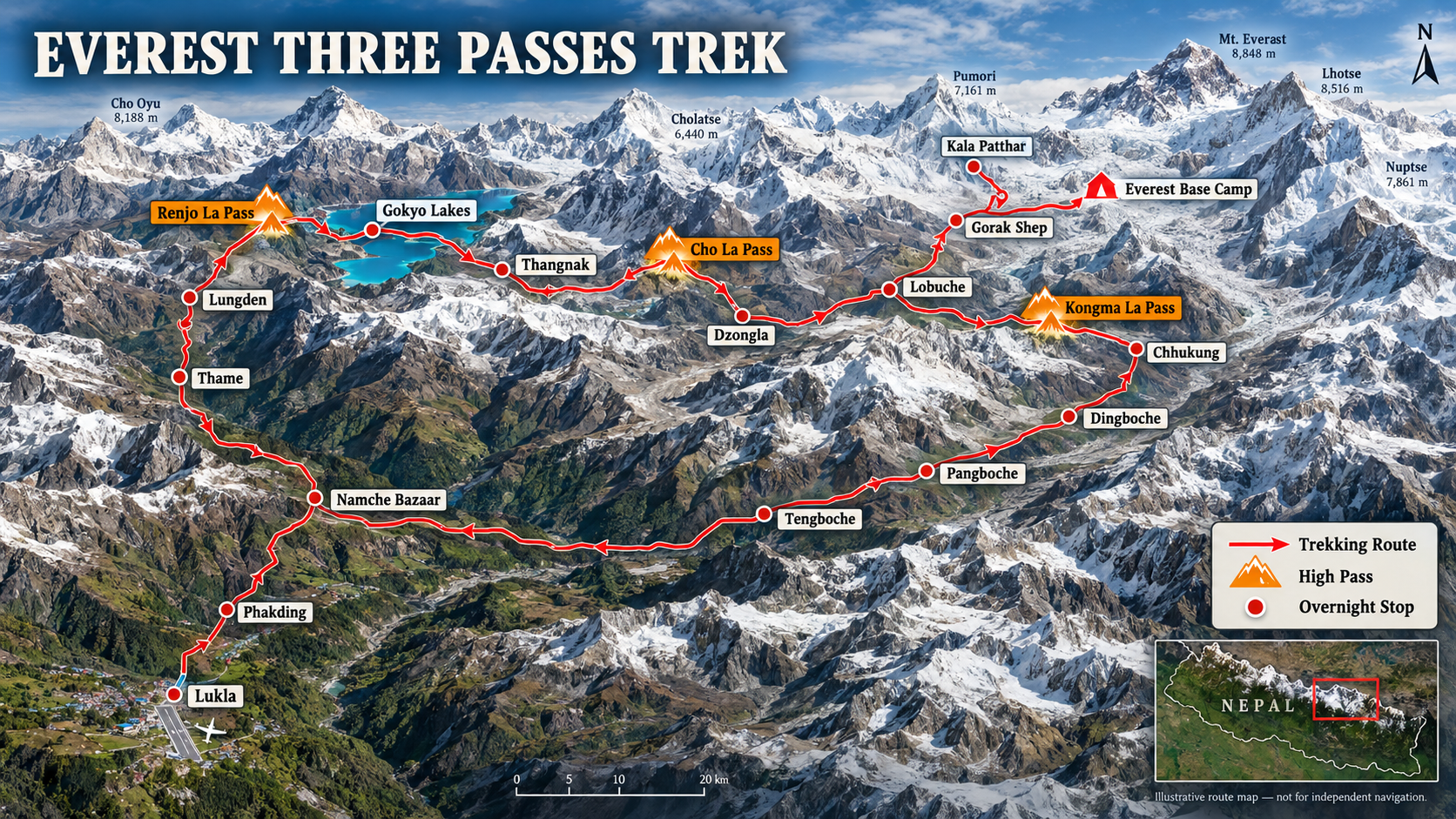
From Namche, different operators complete the circuit clockwise or counterclockwise. A common variation first heads toward Thame and Lungden before crossing Renjo La into the Gokyo Valley. The trail then continues across or near Ngozumpa Glacier toward Cho La, Dzongla, and Lobuche.
After visiting Everest Base Camp and Kala Patthar, trekkers continue toward Chhukung and cross Kongma La. The exact sequence can change according to the itinerary design, weather, trail conditions, and the guide’s safety assessment.
Key locations commonly included on the route are
Namche Bazaar → Thame → Lungden → Renjo La → Gokyo → Thangnak → Cho La → Dzongla → Lobuche → Gorak Shep → Everest Base Camp → Kala Patthar → Kongma La or Chhukung Valley → Tengboche → Namche Bazaar → Lukla
Travelers especially interested in the lake section can read the complete Gokyo Valley Trekking guide before comparing the two journeys.
Understanding the Everest Three Passes Trek Map
An Everest Three Passes The trek map should display more than a simple line between villages. A useful map should include:
- Overnight settlements
- The three high passes
- Acclimatization locations
- Major viewpoints
- Everest Base Camp
- Gokyo Lakes
- Glaciers and river valleys
- Alternative or emergency descent routes
- Daily elevation changes
A digital map is helpful for planning, but it should never replace an experienced guide’s judgment. Snow can hide the trail, glacier movement may affect crossings, and changing weather can make a familiar route difficult to follow.
The official Sagarmatha National Park website provides background information about the protected region. The park was established in 1976 and covers approximately 1,148 square kilometers of the Solukhumbu District. (snp.gov.np)
Everest Three Passes Trek Distance
The Everest Three Passes Trek distance is not identical for every package. Variations arise from acclimatization hikes, the direction of travel, overnight stops, viewpoint excursions, and whether all optional side trips are completed.
Most full circuits cover approximately 160 to 200 kilometers on foot. The distance may appear manageable when divided across several weeks, but kilometers alone do not explain the challenge.
At high altitude, a short day can feel harder than a much longer walk at lower elevation. Trekkers must navigate steep stone trails, loose rock, moraine, ice, snow, and glacier sections. Crossing a pass can require an early departure and seven to nine hours of sustained walking.
For SEO and visitor clarity, the distance should therefore be presented as an estimated range rather than a guaranteed fixed number.
Everest Three Passes Trek Difficulty
The Everest Three Passes Trek difficulty is best described as challenging to strenuous. It is more demanding than the standard Everest Base Camp route because it combines multiple elevations above 5,000 meters with steep, remote pass crossings.
The trek does not normally require technical mountaineering, but that does not make it easy. Snow or ice may require extra equipment and careful footwork. Conditions can change quickly, and portions of the route are far from immediate assistance.
What Makes the Trek Challenging?
The main physical and environmental challenges include:
- Three passes above 5,000 meters
- Long trekking days
- Repeated ascents and descents
- Cold mornings and freezing nights
- Uneven moraine and glacial terrain
- Possible snow and ice on the passes
- Lower oxygen levels
- Limited facilities in remote settlements
- Changing visibility and weather
- Several consecutive days of physical exertion
Previous Himalayan experience is beneficial, although determined first-time high-altitude trekkers can complete the route with proper training, acclimatization, professional guidance, and a sensible schedule.
Anyone with heart, lung, circulation, or other significant medical conditions should consult a qualified medical professional before committing to this trip.
Altitude and Acclimatization
Altitude is the most important health consideration on the Everest Three Passes Trekking. Sleeping elevations rise gradually after Lukla, but the body still needs sufficient time to adapt.
The 20-day structure should contain acclimatization opportunities around locations such as Namche Bazaar, Gokyo, Dingboche, or Chhukung, depending on the direction of travel.
The body’s most important early acclimatization response develops during the first several days at altitude. The CDC’s high-altitude guidance emphasizes gradual ascent and sufficient time for the body to adjust. (cdc.gov)
Possible symptoms of acute mountain sickness include:
- Headache
- Nausea
- Unusual fatigue
- Poor appetite
- Dizziness
- Disturbed sleep
- Reduced coordination
- Breathlessness that feels excessive for the activity
Symptoms should never be hidden from the guide. Continuing upward while symptoms become worse can lead to serious illness. The Himalayan Rescue Association’s altitude advice stresses resting or descending when symptoms deteriorate. (himalayanrescue.org)
Acclimatization days are not wasted days. They are a central part of a safe and successful trekking plan.
Best Time for Everest Three Passes Trekking
The best seasons for Everest Three Passes trekking are generally spring and autumn. These periods usually offer the most suitable balance of visibility, operating teahouses, trail access, and manageable weather.
Spring: March to May
Spring brings gradually warmer conditions, longer daylight hours, and colorful vegetation at lower elevations. Mountain visibility is often excellent, particularly during the morning.
Snow may remain on the passes, especially earlier in the season. This can add beauty but may also increase the difficulty of the crossings.
Autumn: Late September to November
Autumn is popular for its generally clear skies, dry trails, and wide Himalayan views. October is often busy on the main Everest Base Camp corridor, although the remote sections between the passes can still feel peaceful.
Temperatures fall significantly later in November. Trekkers should prepare for freezing nights and possible snow.
Winter: December to February
Winter can provide excellent visibility and fewer people, but severe cold, deep snow, strong wind, or ice may make one or more passes unsafe. Some high-altitude lodges may also close.
Winter departures require flexible scheduling, suitable equipment, and experienced local guidance.
Monsoon: June to Early September
Clouds, rain, flight disruption, wet lower trails, and reduced visibility make monsoon trekking more complicated. Conditions can remain dry at times in higher valleys, but reaching the region and crossing exposed terrain may be unpredictable.
See the detailed best trekking season in Nepal guide when comparing monthly conditions.
Everest Three Passes Trek Cost
The Everest Three Passes Trek cost varies according to group size, package inclusions, accommodation level, guide and porter service, transportation, meals, and seasonal demand.
The current Leaf Holidays package is listed from approximately US$1,400 per person, while the published group rates may vary according to the number of participants. Because exchange rates, domestic flight fares, permit policies, and lodge prices may change, travelers should request a written quotation before booking.
What Usually Influences the Price?
The total Everest Three Passes trekking price is affected by:
- Kathmandu hotel category
- Domestic flights to and from Lukla
- Guide and porter arrangements
- Group size
- Number of trekking days
- Meals included in the package
- Permits and local fees
- Airport transfers
- Ground transportation
- Emergency planning
- Seasonal demand
- Private or shared services
- Extra nights caused by weather delays
A low advertised price does not always represent the final cost. Before booking, compare what is included, the guide-to-client ratio, the acclimatization schedule, the porter weight policy, staff insurance, emergency procedure, and cancellation terms.
Required Permits and Entry Fees
Most Everest Three Passes trekking routes require entry documents for Sagarmatha National Park and the local Khumbu area. Requirements and collection procedures can change, so the operator should reconfirm them before departure.
The Nepal Tourism Board’s park-entry information currently lists separate rates for Nepali citizens, SAARC nationals, and other foreign visitors. (ntb.gov.np)
Carry your passport and copies of relevant documents because they may be required at checkpoints. Permit fees should be clearly listed as included or excluded in the final package agreement.
Travelers should also check current visa rules through Nepal’s official Department of Immigration before departure. Visa conditions are separate from trekking permits.
Accommodation on the Trek
Accommodation consists mainly of locally operated teahouses and mountain lodges. Rooms are usually simple, with twin beds, mattresses, blankets, and limited furniture.
Namche Bazaar and some major settlements offer a wider range of rooms. Facilities become more basic near the high passes, where running water, private bathrooms, heating, charging, and internet may be limited.
The dining room is normally the warmest shared area of a lodge. Bedrooms are generally not heated, so a suitable sleeping bag remains essential even when blankets are available.
A luxury Everest Base Camp trek may provide upgraded facilities on the main trail, but luxury options are limited in the remote valleys of the Three Passes circuit.
Food and Drinking Water
Teahouse menus commonly include dal bhat, soup, noodles, rice, potatoes, pasta, eggs, porridge, bread, dumplings, tea, coffee, and simple desserts.
Dal bhat is particularly practical because it combines rice, lentils, vegetables, and carbohydrates needed for long walking days. Food choices may become smaller and more expensive as altitude increases because supplies must be transported into remote settlements.
Safe hydration is essential. Depending on the location, trekkers can obtain boiled water, filtered water, or tap water that must be purified. A reusable bottle and reliable purification method help reduce plastic waste.
Drink regularly, but do not assume that excessive water prevents altitude illness. Acclimatization, gradual ascent, honest symptom reporting, and descent when necessary remain more important.
Physical Training and Preparation
Training should begin at least eight to twelve weeks before departure. The strongest preparation combines cardiovascular fitness, leg strength, balance, and consecutive walking days.
A practical program may include:
- Long-distance walking
- Hill or stair climbing
- Hiking with a loaded daypack
- Squats and lunges
- Step-ups
- Core-strength exercises
- Cycling, swimming, or jogging
- Mobility and balance work
- Back-to-back weekend hikes
Fitness cannot prevent altitude sickness, but it allows the body to manage long trekking days more efficiently. Training also reduces the likelihood of knee pain, muscle fatigue, and poor balance on uneven ground.
Mental preparation matters too. Weather delays, cold mornings, basic accommodation, tired legs, and itinerary changes are normal parts of a major Himalayan journey.
Essential Trekking Equipment
Packing for Everest Three Passes Trekking requires equipment suitable for warm lower valleys, freezing high-altitude mornings, strong wind, and possible snow.
| Item | Recommended Quantity | Packing Note |
|---|---|---|
| Waterproof trekking boots | 1 pair | Break them in before the trek. |
| Moisture-wicking base layers | 2–3 sets | Include long-sleeved tops and bottoms. |
| Insulated mid-layers | 2 | Pack a fleece and a lightweight insulated layer. |
| Down jacket | 1 | Choose a warm, compressible jacket. |
| Waterproof outer shell | 1 set | Include a waterproof jacket and trousers |
| Trekking trousers | 2–3 pairs | Select lightweight, quick-drying fabric. |
| Thermal leggings | 2 pairs | Essential for cold evenings and high passes |
| Warm hat | 1 | Should cover your ears |
| Sun hat or cap | 1 | Choose one with good sun protection. |
| Inner gloves | 1 pair | Lightweight and moisture-wicking |
| Insulated gloves | 1 pair | Waterproof gloves are recommended. |
| UV-protective sunglasses | 1 pair | Category 3 or 4 lenses are preferable. |
| Sleeping bag | 1 | Rated approximately –15°C to –20°C |
| Trekking poles | 1 pair | Useful on steep descents and icy trails |
| Headlamp | 1 | Carry 1–2 sets of spare batteries. |
| Gaiters | 1 pair | Recommended when snow is expected |
| Reusable water bottles | 2 | Total carrying capacity of at least 2 liters |
| Water-purification system | 1 | Carry a filter, tablets, or purification drops. |
| Sunscreen | 1 bottle | SPF 50+ is recommended |
| Lip protection | 1–2 sticks | Use SPF-rated lip balm. |
| Personal first-aid kit | 1 kit | Include personal medicine and blister care. |
| Power bank | 1–2 | A combined capacity of 20,000 mAh is useful. |
| Waterproof document pouch | 1 | Store passports, permits, insurance, and cash. |
Review the complete trekking equipment checklist before preparing your bags.
Microspikes or other traction equipment may be useful when the passes are icy. The guide should assess current conditions and advise whether specialized equipment is required.
Guides, Porters, and Responsible Trekking
A knowledgeable local guide is strongly recommended for this route. The guide monitors altitude symptoms, checks trail and weather conditions, coordinates accommodation, manages emergencies, and makes decisions about whether a pass is safe to cross.
Porters reduce the physical load carried by trekkers, but responsible weight limits must be respected. Pack only what is necessary and confirm the operator’s porter policy before departure.
Responsible travel also includes:
- Carrying reusable bottles
- Avoiding single-use plastic
- Taking batteries and non-biodegradable waste out
- Using established toilets
- Staying on recognized trails
- Respecting wildlife
- Walking clockwise around mani walls and religious structures
- Asking permission before photographing local people
- Supporting locally operated lodges and businesses
The Everest region is not just a trekking destination. It is the home of Sherpa communities with living religious traditions, working villages, and close connections to the mountain environment.
Travel Insurance and Emergency Planning
Standard holiday insurance may not cover trekking above 5,000 metres. Your policy should explicitly cover:
- Trekking up to the maximum planned altitude
- Emergency helicopter evacuation
- High-altitude medical treatment
- Trip interruption
- Domestic flight delay or cancellation
- Baggage loss or delay
- Activities included in the confirmed route
Read the policy carefully instead of relying on general marketing language. Keep the insurer’s emergency contact number, policy details, and claim procedure accessible offline.
The travel insurance guide explains what trekkers should check before entering remote mountain areas.
Even with suitable coverage, rescue is not guaranteed to be immediate. Visibility, wind, location, and daylight can affect helicopter operations. Prevention, acclimatization, and early decision-making remain the strongest safety measures.
Lukla Flights and Weather Flexibility
Lukla flights depend heavily on visibility and weather. Delays, diversions, airport changes, or cancellations can occur even during the main trekking seasons.
Travelers should keep at least one or two flexible days before their international departure. Booking an inflexible flight immediately after the expected return from Lukla creates unnecessary risk.
Helicopter transfers may sometimes be available when fixed-wing flights are disrupted, but they depend on weather, aircraft availability, passenger numbers, and additional payment. They should not be treated as a guaranteed backup.
Is the Everest Three Passes Trek Worth It?
Everest Three Passes Trekking is worth considering if you want more than a direct walk to Everest Base Camp. It offers a complete circuit through Gokyo, remote valleys, glaciers, Sherpa settlements, famous viewpoints, and three physically demanding passes.
It is best suited to trekkers who:
- Have good physical fitness
- Can walk for several consecutive days
- Are comfortable with basic mountain accommodation
- Understand the risks of high altitude
- Can tolerate cold and unpredictable conditions
- Value scenery and challenge over comfort
- Have enough time for acclimatization
- Accept that safety may require itinerary changes
Travelers with limited time or less high-altitude experience may prefer an Everest Base Camp Short Trek or a standard Everest Base Camp program.
Plan Your Everest Three-Passes Trek for 2027
A successful Everest Three Passes Trek depends on more than reaching three high points. It requires a realistic 20-day schedule, gradual acclimatization, strong physical preparation, appropriate insurance, dependable equipment, and guides who are prepared to change plans when conditions become unsafe.
The route brings together many of the Everest region’s greatest experiences: the Gokyo Lakes, Ngozumpa Glacier, Everest Base Camp, Kala Patthar, Sherpa culture, and sweeping views of Everest, Lhotse, Makalu, Cho Oyu, Ama Dablam, and other Himalayan peaks.
For updated availability, inclusions, group discounts, and a personalized quotation, contact Leaf Holidays Treks & Expeditions. The team can help you review the 20-day program, prepare for the three pass crossings, and choose a departure suited to your experience and preferred season.
Prices, permits, flights, weather, and trail conditions may change. Confirm all arrangements with the trekking company before booking.
Detail Itinerary of Everest Three Passes Trek 2027: Cost, Route & Itinerary
Day 01: Arrival at Kathmandu
Once you arrive at the Tribhuwan International Airport, our company representatives will meet and greet you and then take you to your hotel, where you will check in and spend the night. You can take this time to rest and relax before starting your Himalayan adventure.
Highest Altitude
1300m. (Kathmandu)
Meals
Breakfast
Accommodation
HotelDay 02: Sightseeing of Kathmandu and Bhaktapur city
Enjoy a guided sightseeing tour of Kathmandu’s UNESCO World Heritage Sites, including Kathmandu Durbar Square, Pashupatinath, Boudhanath, Swayambhunath, Patan, and Bhaktapur Durbar Squares. Explore ancient palaces, sacred temples, Buddhist stupas, and traditional Newari architecture. Overnight at a hotel in Kathmandu.

Activity & Duration
Sightseeing
Highest Altitude
1300m. (Kathmandu)
Meals
Breakfast
Accommodation
HotelDay 03: Kathmandu to Lukla and trek to Phakding (2610m) 2-3 hours
After breakfast, we take a 40-minute scenic flight to Lukla. If the weather is good, we’ll get amazing views of the mountains and deep valleys. From Lukla, we start our trek alongside the Dudh Koshi River. You’ll get to see stunning views of crystal-clear mountains like Mt. Nupla (5885 m), Kusum Kangaru, and the Kwongde range. After an easy walk for about 2 hours, we’ll reach the village of Phakding, where we’ll stay overnight at a guest house.
Activity & Duration
Trerkking, 2-3 hours
Highest Altitude
2610m. (Phakding)
Meals
Breakfast, lunch and dinner
Accommodation
GuesthouseDay 04: Phakding to Namche Bazzar (3440m) 6-7hours
We begin the trek from Phakding, walking alongside the Dudh Koshi River and crossing small suspension bridges. After reaching the village of Monjo, we enter the Sagarmatha National Park and start ascending towards Jhor. On this trail, we pass through waterfalls and witness beautiful scenery with lush forests of rhododendron, magnolia, and fir. Finally, we reach the picturesque village of Namche Bazzar, which offers breathtaking views and is a comfortable place to spend the second night of the trek.
Activity & Duration
Trekking, 5-6 hours
Highest Altitude
3440m. (Namche Bazzar)
Meals
Breakfast, lunch and dinner
Accommodation
GuesthouseDay 05: Acclimatize at Namche Bazaar
Spend an acclimatization day in Namche Bazaar with an optional hike to nearby viewpoints or Sherpa villages. Explore the museum, monasteries, cafes, and local shops while adjusting to the altitude. Overnight at a lodge in Namche Bazaar.
Highest Altitude
3440m. (Namche Bazaar)
Meals
Breakfast, lunch and dinner
Accommodation
lodgeDay 06: Namche Bazzar to Thame (3800m) 5-6 hours
Trek from Namche Bazaar to Thame through pine and rhododendron forests, passing Thamo village, Thamo Gompa, and the Khumbu hydropower area. After approximately 5–6 hours of walking, reach peaceful Thame and stay overnight at a guesthouse.
Activity & Duration
Trekking, 5-6 hours
Highest Altitude
3800m. (Thame)
Meals
Breakfast, lunch and dinner
Accommodation
GuesthouseDay 07: Thame to Lungden (4380m)
After having breakfast, we will start trekking towards Tarngga from Thame. The trail is easy and gentle. We will cross Marulung on the east bank of Bhotekoshi and then descend to Lungden. On the way, we will see a lot of different plants and animals and experience the unique Sherpa culture. The trail will take us through a narrow valley filled with giant boulders.
Activity & Duration
Trekking, 4-5 hours
Highest Altitude
4380m. (Lungden )
Meals
Breakfast, lunch and dinner
Accommodation
GuesthouseDay 08: Lungden – Renjo la Pass (5360m) – Gokyo Lake (4700m) walking hours: 7-8 hours
After crossing the Renjo La pass, you will descend to a valley with stunning views. The trail passes by three beautiful lakes—Longpongo, Taboche Tsho, and Dudh Pokhari—each one connected by a stream. Gokyo village is located near the third lake and offers breathtaking views of the surrounding mountains, including Cho Oyu, Gyachung Kang, Lhotse, Makalu, Cholatse, and Tawache.
Activity & Duration
Trekking, 7-8 hours
Highest Altitude
5360m. (Renjo la Pass)
Meals
Breakfast, lunch and dinner
Accommodation
GuesthouseDay 09: Gokyo Lake exploration
Spend the day exploring Gokyo’s beautiful lakes and nearby viewpoints. Enjoy panoramic views of Ngozumpa Glacier, Cho Oyu, Everest, Lhotse, Makalu, and Gyachung Kang, with an optional visit to the fourth and fifth lakes. Overnight in Gokyo.
Highest Altitude
4700m. (Gokyo Lake)
Meals
Breakfast, lunch and dinner
Accommodation
GuesthouseDay 10: Trekking down to Thangnak (4700m) walking hours: 5 hours
Today we will walk downhill from Gokyo to Thangnak, which will take around 4 hours. On the way, we will be able to admire the beautiful view of the Gokyo Lake and cross the Gokyo glacier. We will spend the night in Thangnak.
Activity & Duration
Trekking, 5 hours
Highest Altitude
4700m. (Thangnak)
Meals
Breakfast, lunch and dinner
Accommodation
GuesthouseDay 11: Thangnak to Dzongla (4830m)
Today we will trek up from Thangnak to Dzongla by ascending through the valley. We will spend the night at Dzongla.
Activity & Duration
Trekking, 7-8 hours
Highest Altitude
4830m. (Dzongla)
Meals
Breakfast,, lunch and dinnerr
Accommodation
GuesthouseDay 12: Dzongla to Lobuche (4940m) walking hours: 3-4 hours
The trek starts with a pleasant walk between snow-capped peaks. The trail leads towards the east, passing through dark boulders below Cholatse Mountain. Along the way, you’ll see the impressive Ama Dablam peak (6856m). After about 3-4 hours of hiking, you’ll reach Lobuche (4940m), where you can admire the glaciers flowing down from the Lobuche peak. The towering Tawoche and Nuptse peaks are particularly stunning from Lobuche.
Activity & Duration
Trekking, 3-4 hours
Highest Altitude
4940m. (Lobuche )
Meals
Breakfast, lunch and dinner
Accommodation
GuesthouseDay 13: Lobuche to Gorakshep (5170m), trekking to Everest Base camp (5364m) back to Gorakshep (5170m) 3-4 hours
Trek from Lobuche to Gorak Shep through rocky glacial moraine, enjoying views of Pumori and Nuptse. After lunch, continue to Everest Base Camp, explore the dramatic Himalayan surroundings, and return to Gorak Shep for an overnight stay.
Activity & Duration
Trekking, 3-4 hours
Highest Altitude
5164m. (Gorakshep)
Meals
Breakfast, lunch and dinner
Accommodation
GuesthouseDay 14: Gorakshep to Kalapatthar (5644m) and back to Lobuche (4940m)
Today’s trek is a long one, lasting about 5-7 hours. We start early in the morning to climb Kalapathar and get a stunning 360-degree view of Mount Everest and other mountains like Pumori, Lingtren, Khumbetse, Nuptse, Lhotse, Ama Dablam, and Thamserku. After enjoying the view, we take an easy walk for about 2 hours to reach Lobuche.
Activity & Duration
Trekking, 5-7 hours
Highest Altitude
4940m. (Lobuche)
Meals
Breakfast, lunch and dinner
Accommodation
GuesthouseDay 15: Lobuche to - Khongma La Pass – Chhukung (5550m) 7-8 hours
We will have an easy ascent from Lobuche and pass through small frozen lakes. Then we will descend to Khongma La Pass, where we will see a crane mummy wrapped in prayer flags. After that, we will descend to the east side of the Niyang Khola valley, where we can enjoy great views of Island Peak and the jagged ridge of Amphu Lapcha. Our night stay will be in Chhukung, where we will meet climbers who are preparing for Island Peak climbing.
Activity & Duration
Trekking, 7-8 hours
Highest Altitude
5550m. (Chukung )
Meals
Breakfast, lunch and dinner
Accommodation
GuesthouseDay 16: Chhukung to Tengboche (3867m) walking hours: 4-5 hours
We will walk down the Imja Khola valley, passing through Dingboche village and beautiful potato fields. Then we will continue through alpine pastures and reach the highest year-round settlement in the valley, Pangboche. From there, we will enjoy stunning views of peaks like Amadablam, Everest, Nuptse, and Lhotse. We will also visit the largest Buddhist monastery in the Khumbu region at Tengboche.
Activity & Duration
Trekking, 4-5 hours
Highest Altitude
3867m. (Tengboche)
Meals
Breakfast, lunch and dinner
Accommodation
GuesthouseDay 17: Tengboche to Namche (3440m) 5-6 hours
Today we will cross a suspension bridge over the Dudh Koshi River and continue trekking to Kyanjuma. Here, we will come across a junction leading to Gokyo Valley, Khumjung village, and Namche Bazzar. The rhododendron forest in this area is home to various species of wildlife, such as pheasants, Himalayan Griffons, musk deer, and wild goats. In the evening, we will explore the surrounding area with its beautiful scenery. We will spend the night in Namche.
Activity & Duration
Trekking, 5-6 hours
Highest Altitude
3440m. (Namche)
Meals
Breakfast, lunch and dinner
Accommodation
GuesthouseDay 18: Namche Bazaar trekking back to Lukla (2860m)
We will walk downhill from Namche to the Dudh Koshi River, which can be tough on the knees. After crossing a high suspension bridge, the path is mostly level and passes through beautiful rhododendron and pine forests. We will enjoy views of distant snow-covered peaks and pass through local Sherpa villages before reaching Phakding. From there, we’ll continue to Lukla, passing through lush green forests and enjoying incredible mountain scenery. In Lukla, we’ll have time to explore the local area and enjoy a traditional Nepalese dinner with a cultural show in the evening.
Activity & Duration
Trekking, 6-7 hours
Highest Altitude
2860m. (Lukla )
Meals
Breakfast, lunch and dinner
Accommodation
GuesthouseDay 19: Flight from Lukla to Kathmandu
After bidding farewell to our porters, we will take a 40-minute flight back to Kathmandu. In case of bad weather in Lukla, this day can also be used as a spare day. In the evening, we will have a farewell dinner and discuss plans for your next adventure.
Activity & Duration
Flight, around 30 minutes
Highest Altitude
1300m. (Kathmandu)
Meals
Dinner
Accommodation
HotelDay 20: Transfer to the airport for the final departure
Two hours before your flight, our representative will take you to the airport. We hope you had a wonderful trekking experience in Nepal and will cherish the memories of your time in the Himalayas.
Highest Altitude
1300m. (Kathmandu)
Meals
Breakfast
Accommodation
Hotel
- The itinerary may change because of weather, trail conditions, flight delays, or safety concerns.
- Walking times and distances are approximate and depend on individual pace.
- Proper acclimatization is essential before crossing the three high passes.
- Renjo La, Cho La, and Kongma La crossings depend on snow, ice, and weather conditions.
- Alternative routes may be used if a pass is unsafe or inaccessible.
- Lukla flights are weather-dependent; keep at least one additional buffer day.
- Accommodation becomes basic at higher elevations and remote settlements.
- Inform your guide immediately if you experience symptoms of altitude sickness.
- Travel insurance must cover trekking above 5,500 meters and emergency helicopter evacuation.
- The guide’s decision will be final when route changes are required for safety.
Includes and Excludes
What is included?
- Airport pickups and drops in a private vehicle
- Hotel accommodation in Kathmandu with bed and breakfast
- Teahouse accommodation during the trek
- All meals (breakfast, lunch, and dinner) during the trek
- Welcome and farewell dinners
- All ground transportation on a comfortable private vehicle as per the itinerary
- Domestic flights (Kathmandu-Lukla-Kathmandu)
- An experienced, English-speaking, and government-licensed holder of Guide and Porter service
- Staff costs, including their salary, insurance, equipment, domestic airfare, food, and accommodation
- Down jacket (to be returned after trip completion)
- All necessary paperwork and trekking permits (National Park Permit, TIMS)
- Medical kit (carried by your trek leader)
- All government and local taxes
What is excluded?
- Nepalese visa fee
- Excess baggage charge(s)
- Extra night accommodation in Kathmandu because of early arrival, late departure, early
- Return from the mountain (due to any reason) than the scheduled itinerary
- Emergency expenses like rescues and emergency medical treatment.
- Personal insurance charges.
- International flights
- Travel and rescue insurance
- Personal expenses (phone calls, laundry, bar bills, battery recharge, extra porter, bottle or boiled water, shower, etc.)
- Tips for guide(s), porter(s), and driver(s)
Trip Information
| Trip Information | Details |
|---|---|
| Trip Name | Everest Three Passes Trekking |
| Trip Duration | 20 days |
| Destination | Everest Region, Nepal |
| Trekking Area | Sagarmatha National Park, Solukhumbu |
| Trip Style | High-altitude teahouse trekking |
| Trip Difficulty | Challenging to strenuous |
| Maximum Altitude | Approximately 5,550 meters |
| Three Major Passes | Renjo La, Cho La, and Kongma La |
| Renjo La Elevation | Approximately 5,360 meters |
| Cho La Elevation | Approximately 5,420 meters |
| Kongma La Elevation | Approximately 5,535 meters |
| Everest Base Camp Elevation | 5,364 meters |
| Estimated Trekking Distance | Approximately 160–200 km |
| Daily Walking Duration | Approximately 5–8 hours |
| Longest Walking Days | Approximately 7–9 hours during pass crossings |
| Starting Point | Kathmandu, with a flight to Lukla |
| Trek Starting Point | Lukla |
| Ending Point | Lukla, followed by a flight to Kathmandu |
| Major Attractions | Three high passes, Everest Base Camp, Kala Patthar, Gokyo Lakes, Namche Bazaar, and major glaciers |
| Mountain Views | Everest, Lhotse, Makalu, Cho Oyu, Ama Dablam, Nuptse, Pumori, and Cholatse |
| Major Glaciers | Khumbu Glacier and Ngozumpa Glacier |
| Accommodation in Kathmandu | Three- or four-star hotel, depending on the package |
| Accommodation During Trek | Local teahouses and mountain lodges |
| Meals in Kathmandu | Breakfast |
| Meals During Trek | Breakfast, lunch, and dinner |
| Transportation | Private airport transfers and domestic flights |
| Kathmandu–Lukla Transport | Scheduled mountain flight, subject to weather |
| Group Size | 2–20 participants |
| Best Trekking Seasons | March–May and late September–November |
| Winter Availability | Possible with additional preparation and flexible routing |
| Monsoon Availability | Possible but generally not recommended |
| Required Permits | Sagarmatha National Park entry and applicable Khumbu local permit |
| Guide | Licensed and experienced trekking guide recommended |
| Porter Service | Available according to the selected package |
| Acclimatization | Essential; dedicated acclimatization days are included. |
| Physical Fitness | Good cardiovascular endurance and strong walking fitness are required. |
| Previous Experience | High-altitude trekking experience is beneficial but not compulsory. |
| Technical Climbing | Normally not required |
| Possible Trail Conditions | Rock, snow, ice, moraine, glacier, and steep mountain paths |
| Drinking Water | Boiled, filtered, or purified water |
| Electricity and Charging | Available at many lodges for an additional fee |
| Internet Access | Wi-Fi or mobile connectivity may be available for an additional fee. |
| Shower Facilities | Available at selected lodges for an additional charge |
| Travel Insurance | Mandatory; must cover trekking above 5,500 metres and helicopter evacuation |
| Starting Package Price | Approximately US$1,400 per person |
| Currency Required | Nepalese rupees for personal expenses during the trek |
| Emergency Support | First-aid support, evacuation coordination, and access to high-altitude medical assistance |
| Suitable For | Fit and experienced adventure trekkers |
| Not Recommended For | Travelers with serious heart, lung, or mobility conditions without medical approval |
Trip Reviews
Price starts
US$ 1400
Need Help?
Ask to Travel Expert