
- Mt. Kailash Tour
- Kailash Mansarovar Overland Tour
- Kailash Mansarovar Yatra by Helicopter – Complete Spiritual Journey Guide
- Kailash Yatra via Lucknow
- Kailash Mansarovar Tour via Lhasa
- Kailash Lhasa EBC Tour From Beijing
- Kailash Heli Tour via Kerung: Complete Spiritual Journey Guide
- Kailash Tour via Lhasa In Kerung Out
- Lhasa EBC Kailash Tour
- Kailash Heli Tour
- Kailash Mansarovar Yatra from Nepal 2027: Cost & Itinerary
- Kailash Nandi Kora
- Kailash Tour via Humla Simikot – 20 Days
- Mount Kailash Tour: 7 Amazing Experiences in 2027
- Trekking
-
-
- Everest Region
- Luxury Everest Base Camp Trek: 7 Unforgettable Highlights
- Everest Base Camp Trek 2026: Cost, Route, and Complete Guide
- Everest Three Passes Trek 2027: Cost, Route & Itinerary
- Everest Base Camp Short Trek
- Everest Panorama Trek: Amazing 10-Day Cost & Itinerary
- Everest Base Camp Island Peak Trek: Complete 19-Day Guide
- Gokyo Valley Trekking 2027: Easy Guide to Cost & Itinerary
- Mera Peak Climbing 2027: Complete Cost & Itinerary Guide
- Rolwaling Valley Trek: 23-Day Itinerary, Cost, Permits & Difficulty
- Dolpo Region Trek
- Everest Region
-
- Annapurna Region
- Annapurna Base Camp Trekking
- Annapurna Circuit Trek
- Annapurna Base Camp Trek: 7 Amazing Cost & Route Tips
- Mardi Himal Trek: 7 Amazing Highlights & Complete Guide
- Annapurna Alternative Combine Trek: 18 Amazing Days
- Mohare Dada Trek
- Ghorepani Poon Hill Trek: 7 Unforgettable Highlights
- Khopra Ridge Community Trek: 13-Day Ultimate Adventure
- Damodar Kunda Trek: 10-Day Ultimate Sacred Adventure
- Upper Mustang Trek: 10 Amazing Sights : Ultimate Guide
- Jomsom Muktinath Trek: Amazing 12-Day Ultimate Guide
- Ghale Gaun Trek: 7 Amazing Reasons : Ultimate Guide
- Dhampus Sarangkot Trek: 7 Incredible Experiences
- Dhaulagiri Region
- Annapurna Region
-
-
- Tours
-
-
- Day Tours
- Rickshaw–a three-wheeler Tour
- Pharping Dakshinkali Day Tour: 7 Amazing Highlights
- Historical Tour: 7 Amazing Places to Explore
- Kathmandu Temple Tour: 7 Amazing Spiritual Places
- Nagarkot Tour
- Bhaktapur City Tour: 7 Amazing Places to Explore
- Kathmandu City Tour – Complete Heritage & Cultural Experience in Nepal
- Chandragiri Hill: A Scenic Himalayan Escape Near Kathmandu
- Chitlang Hiking
- Shivapuri to Sundarijal Day Hiking
- Kulekhani Dam Day Tour — Complete Travel Guide
- Day Tours
-
- Package Tours
- Mustang Tour on Jeep
- Nepal Tour Package for Nepali: 12 Amazing Destinations to Explore (2026)
- Muktinath Tour: Complete Guide to Nepal’s Sacred Himalayan Pilgrimage
- 3N,4D Kathmandu Pilgrimage Tour
- Nepal Buddhist Pilgrimage Tour: 7 Sacred Sites Not to Miss
- 6D Nepal Pilgrimage Tour: 7 Amazing Sacred Places
- 7 Nights, 8 Days Nepal Tour
- Districts tour of Nepal
- Janakpur Tour Package: Price, Family Tour & Travel Guide from Kathmandu 2026
- Short Hike in Nepal: 7 Best Easy Treks for Beginners
- Package Tours
-
-
- Outbound
-
- Activities
- Climbing
- Bungee Jumping in Nepal
- Heli Skiing Adventure in the Himalayas
- Canoeing in Nepal
- Mountain Flight in Nepal
- Zip Flyer in Pokhara: The Ultimate Adventure Experience
- Paragliding in Pokhara: 7 Amazing Reasons to Experience Nepal’s Best Adventure
- Kathmandu Cycling Tour: 9 Amazing Adventures
- Rafting
- Rock Climbing
- Company
- Travel Info
- Travel Insurance
- Recommended Medical Kit
- Nepal Visa Information
- Flight delays and cancellation in Nepal
- Electricity in Nepal: Rates, Bill Check, Calculator and NEA Services
- Trekking Equipment Checklist: 40 Essential Items
- Best Kailash season in Tibet
- Best Trekking season in Nepal
- Trekking in Nepal 2027: 15 Best Himalayan Adventures
- Blogs
- Contact


WhatsApp
+977-9851035239

Email Us
[email protected]
Ghode Jatra in Nepal: History, Meaning and Celebration
25 January 2018
By Leaf Holidays
Ghode Jatra in Nepal: The Festival That Stops a City in Its Tracks
Every year, something extraordinary happens in the heart of Kathmandu. Schools close. Offices empty. The president and prime minister take their seats in a viewing gallery. And then the thunder begins.
Hooves pound the earth at Tundikhel as hundreds of soldiers on horseback launch into precision drills, acrobatics, and breathtaking cavalry displays. The crowd roars. Drums echo off ancient temple walls. And for a few electric hours, the entire Kathmandu Valley holds its breath.
This is Ghode Jatra in Nepal, the Festival of Horses, and it is unlike any celebration you have ever witnessed.
The Ghode Jatra festival is a very important cultural celebration in Nepal that has been taking place for centuries. It has deep roots in Hindu myths and legends, symbolizing the victory of good over evil forces. The highlight of the festival is the grand parade of beautifully decorated horses marching through the streets of Kathmandu.
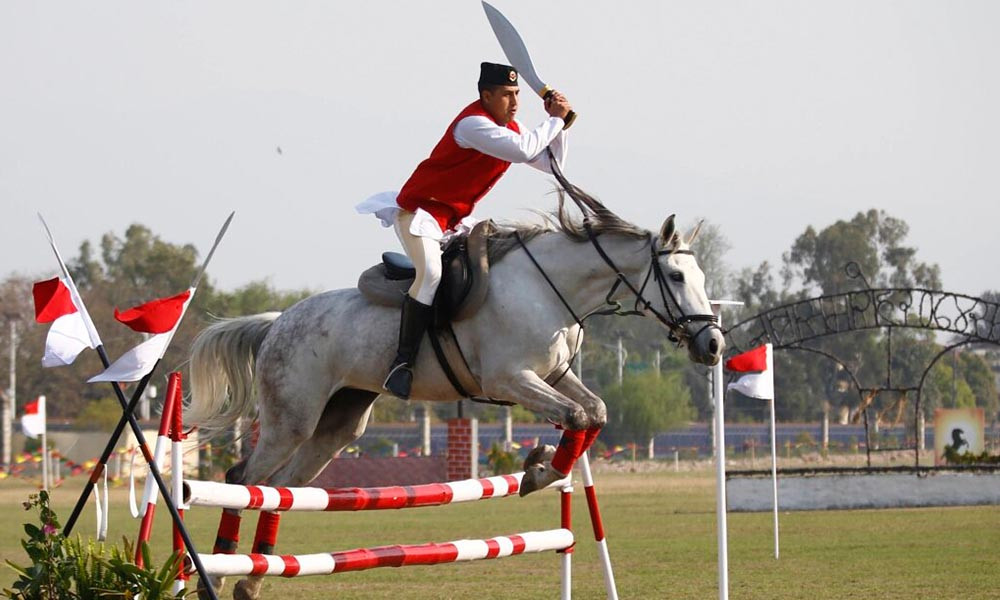
But here is what most people do not know. Beneath the spectacle of galloping horses and military parades, Ghode Jatra hides a collection of stories so dark, so dramatic, and so deeply human that they will make your jaw drop. Stories of demons buried alive under thundering hooves. Of kings driven by jealousy to extraordinary acts of pride. Of gamblers, goddesses, stolen gold plates, and spirits that locals still believe walk the grounds of Tundikhel today.
This complete Ghode Jatra deep dive covers the five most shocking stories behind the festival, the full Ghode Jatra history that shaped modern Nepal, when Ghode Jatra in Nepal is celebrated on the Nepali date 2083, why it is celebrated, and everything you need to witness this extraordinary event for yourself.
What is Ghode Jatra in Nepal?
Before the stories unfold, understanding what Ghode Jatra in Nepal actually is forms the essential foundation. “Ghode Jatra” translates directly as “Horse Parade,” with “Ghode” meaning “horse” and “Jatra” meaning “festival” or “procession.” But calling Ghode Jatra a simple horse parade is like calling the Himalayas a row of hills.
Ghode Jatra stands as one of Kathmandu’s most significant traditional festivals and reflects the deep cultural heritage of the Newar community and the historical identity of the Kathmandu Valley. People observe the festival each year around late March or early April. The celebration centers on a grand horse procession that represents ancient Hindu legends, especially the victory of Lord Bhairav over the demon, symbolizing the defeat of evil forces that once threatened the valley and strengthening long-held beliefs about protection, bravery, and balance within the community.
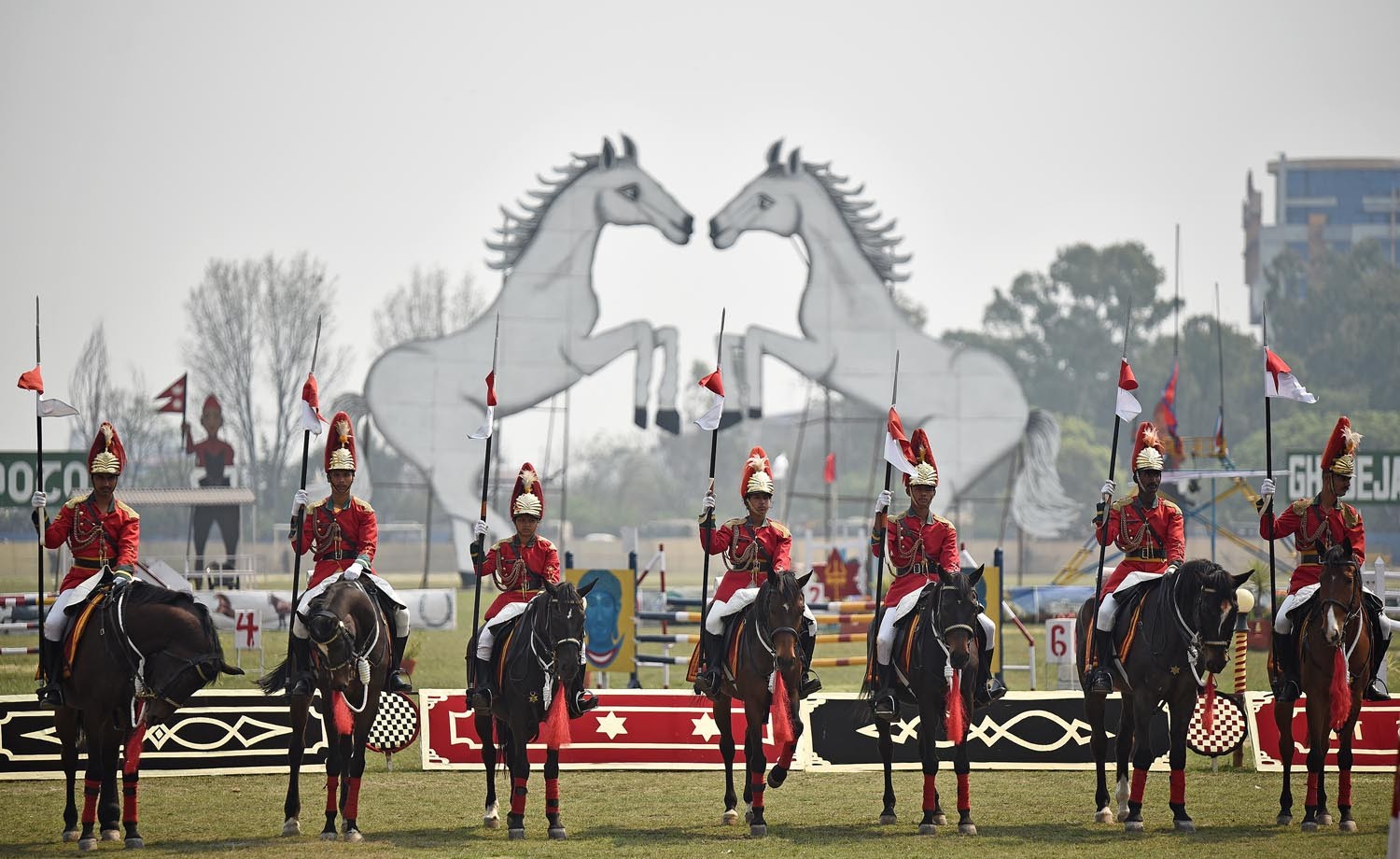
Ghode Jatra is the vibrant festival celebrated annually in the Kathmandu Valley of Nepal. It symbolizes the victory of good over evil and honors the equine spirit. This festival holds great importance among the Newar community of the Kathmandu Valley and is celebrated with great enthusiasm and joy. The festival is celebrated with various activities like horse parades, horse races, tug-of-war, traditional dance and cultural performances, community gatherings, and religious ceremonies.
Ghode Jatra in Nepal is simultaneously an ancient myth, a royal legacy, a military tradition, and a living community celebration. It belongs equally to the Newar grandmother preparing a ceremonial feast and the Nepal Army soldier performing equestrian stunts at 6 AM. Understanding Ghode Jatra means understanding all of these layers at once.
When is Ghode Jatra on the Nepali date 2083?
Before diving into the shocking stories, here is the essential timing every visitor searching for Ghode Jatra in Nepal needs to know.
Ghode Jatra means “horse parade,” which is a fitting title given the day’s events. The Newari people of Nepal celebrate a three-day festival each year called Pahachare, the second day of which is known as Ghode Jatra. The holiday is kept according to the local lunar calendar, but it falls anywhere from the middle of March to early April on the Gregorian calendar.
Ghode Jatra, on the Nepali date 2083, falls on the new moon day, Aunsi, of the Chaitra month in the Nepali calendar. Based on the consistent lunar calendar pattern of Ghode Jatra, the festival in Nepali year 2083 BS is expected to fall in late March or early April 2027. The exact Nepali date for Ghode Jatra 2083 is confirmed annually by the Nepal government and published in the official Nepali Patro calendar.
The parade and competitions of Ghode Jatra are carried out in the presence of the head of state. The Nepal Army organizes the parade and competitions. Kathmandu native Newar people mark the festival with a feast. There is a public holiday in Kathmandu on the day of Ghode Jatra.
For reference, Ghode Jatra in Nepal fell on Chaitra 04, 2082, corresponding to March 18, 2026, in the English calendar. For Nepali year 2083, the Ghode Jatra date falls on April 6, 2027, in the Gregorian calendar. If you are traveling to Nepal to experience Ghode Jatra in Nepal firsthand, plan your arrival at least two days before the festival date and book accommodation early.
Ghode Jatra History — Who Started It and Why
The Official Origin of Ghode Jatra
Understanding the full Ghode Jatra history requires knowing that this festival was not born in a single moment. It grew through centuries, shaped by community myth, royal politics, and military tradition.
The history of the Ghode Jatra festival dates back to the Malla dynasty, a period between the 12th and 18th centuries. It is said that the festival was started by King Jayanta Rana in the 17th century as a way to ward off a demon named Tundi who was believed to reside in the area. The festival was first celebrated in the 15th century to honor the demon Tundi and the goddess Taleju Bhawani. Over time, it has evolved to include other activities and has become an important part of Nepalese culture and heritage.

Who started Ghode Jatra in Nepal is therefore not a single name but a lineage. The Newar community planted the seed with the legend of Gurumapa. The Malla kings watered it with royal patronage and political rivalry. The Shah dynasty institutionalized it as a national military celebration. And the Nepali Army has carried it forward into the modern era, making Ghode Jatra one of the most uniquely layered festivals in all of Asia.
The festival originated from the Newar community and later gained prominence as a military event showcasing cavalry skills. The Shah dynasty institutionalized the festival as a national holiday, blending military tradition with cultural heritage.
Every layer of Ghode Jatra history adds a new dimension to what you witness at Tundikhel today. The horses are not just performing. They are carrying centuries of story on their backs.
Story 1 — The Demon Buried Alive Under Tundikhel
This is the story that started Ghode Jatra in Nepal, and it is far darker than any tourist brochure will tell you.
According to local folklore, a demon named Gurumapa once lived in a tree in the southeast of Tundikhel. He would terrorize the city and kidnap children. To stop him, the residents found a way to trample the demon under the hooves of horses. Ghode Jatra was born as a victory celebration. Even today, it is believed that the thundering hooves of the horses keep the demon’s spirit pressed deep into the earth. Elders warn that if the race is not held, the spirit might rise again to cause havoc.
Think about that for a moment. Ghode Jatra in Nepal is not just a celebration. It is a containment ritual. The horses performing at Tundikhel every year are not doing it for show. According to the oldest and most foundational story of Ghode Jatra history, they are keeping a demon imprisoned beneath the soil of Kathmandu.
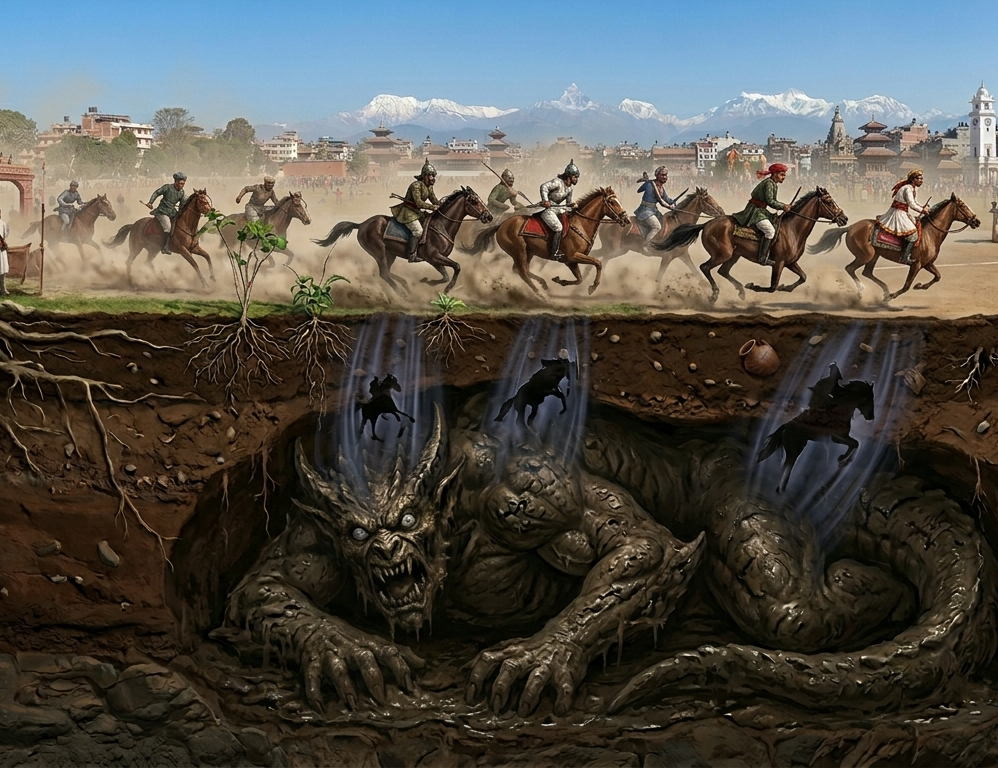
There is a strong belief that the parade of horses at Tundikhel keeps the demon’s spirit away. People believe the faster the horses run, the better Tundi’s spirit is dispelled.
Ghode Jatra is believed to ward off evil spirits and is celebrated to mark the victory over a demon named Tundi. This demon once lived in a meadow, now known as Tundikhel, and constantly terrorized Kathmandu’s ancestors. To put an end to his reign of fear, he was trampled to death by horses and buried under a tree in the heart of Tundikhel. Since then, the festival has been observed annually, with a grand horse parade symbolizing the continued suppression of evil forces.
Every thundering hoof that crosses Tundikhel during Ghode Jatra is, in the belief of many Kathmandu residents, pounding the spirit of Gurumapa deeper into the earth. Stop Ghode Jatra in Nepal for a single year, the elders say, and the demon wakes up.
Story 2 — The Gambler, the Golden Plate, and the Ghost
This is the story of Ghode Jatra that most visitors never hear: a tale of addiction, shame, and a supernatural reckoning that changed Kathmandu forever.
Long ago, in a place called Kutumbahal, there lived a man named KeshChandra. He was clever but had a dangerous habit; he was addicted to gambling. Over time, he lost everything he owned. Out of desperation, he visited his sister, who kindly fed him. However, KeshChandra secretly stole her golden plate and gambled it away. The same thing happened again with a silver plate. Eventually, his sister refused to help him and served food on the ground to teach him a lesson. Ashamed and hungry, KeshChandra left with some rice and went towards the forest near Swayambhunath.
What happened next in that forest became the seed from which an entire dimension of Ghode Jatra history would grow. KeshChandra’s supernatural encounter in the forest, his shame, his transformation, and what he set in motion became one of the foundational legends of why Ghode Jatra is celebrated as a festival of moral reckoning as much as a joyous parade.
The Newar community remembers Kesh Chandra every Ghode Jatra in Nepal not as a villain but as a mirror. A reminder that every community carries within it the seeds of self-destruction and that the festivals that survive through centuries are the ones that hold space for both the darkness and the redemption that follows it.
Story 3 — The King Who Weaponized Ghode Jatra
Ghode Jatra history takes a dramatically political turn during the era of the three kingdoms when Kathmandu, Bhaktapur, and Patan were separate rival kingdoms, each ruled by a Malla king whose pride was as towering as the mountains surrounding the valley.
History tells us that when Kathmandu, Bhaktapur, and Patan were separate kingdoms, King Pratap Malla of Kathmandu was a formidable ruler. Around Nepal Sambat 787, due to a rift between King Pratap Malla and King Shri Niwas Malla of Patan, the festival became an arena of power and prestige.
This is the shocking political secret embedded in Ghode Jatra history. The festival was not always a unified national celebration. For centuries, Ghode Jatra in Nepal was a contested battlefield of royal egos, where the grandeur of your horse parade was a direct public statement of your kingdom’s military power, your cavalry’s skill, and your personal authority as a ruler.
Kings competed through horses. The quality of a king’s procession at Ghode Jatra was a declaration that every rival ruler across the valley could see, judge, and fear. To have a magnificent Ghode Jatra was to be a great king. To have a weak one was to invite contempt from your rivals and doubt from your own people.
This political dimension of Ghode Jatra history explains why the festival evolved so rapidly from a community demon-warding ritual into an elaborate military spectacle. Because in the Kathmandu Valley, power has always been performed as much as exercised. And Ghode Jatra in Nepal became the grandest stage on which that performance played out.
Story 4 — The Goddess Who Demands to Be Present at Ghode Jatra
Among the most striking layers of Ghode Jatra in Nepal is the parallel religious celebration that most tourists completely miss while watching the horse parade at Tundikhel.
Beyond the horses, the day is deeply significant as it coincides with Pahan Charhe, a time when the historic streets of Asan and Indrachowk fill with color as beautiful chariot parades of local deities meet in the squares. Ghode Jatra offers a powerful look into Nepal’s living history, its celebration of spring, and the brave traditions that bind its people together.
Temples throughout Kathmandu Valley host special ceremonies, with Bhadrakali Temple near Tundikhel conducting elaborate rituals to honor protective deities.
Hindu priests carry out important rituals during the festival, including the renewal of a Vishnu statue and special pujas. Cultural groups perform mask dances that bring old stories and legends to life. Traditional music and smaller processions add to the festive mood of Ghode Jatra.
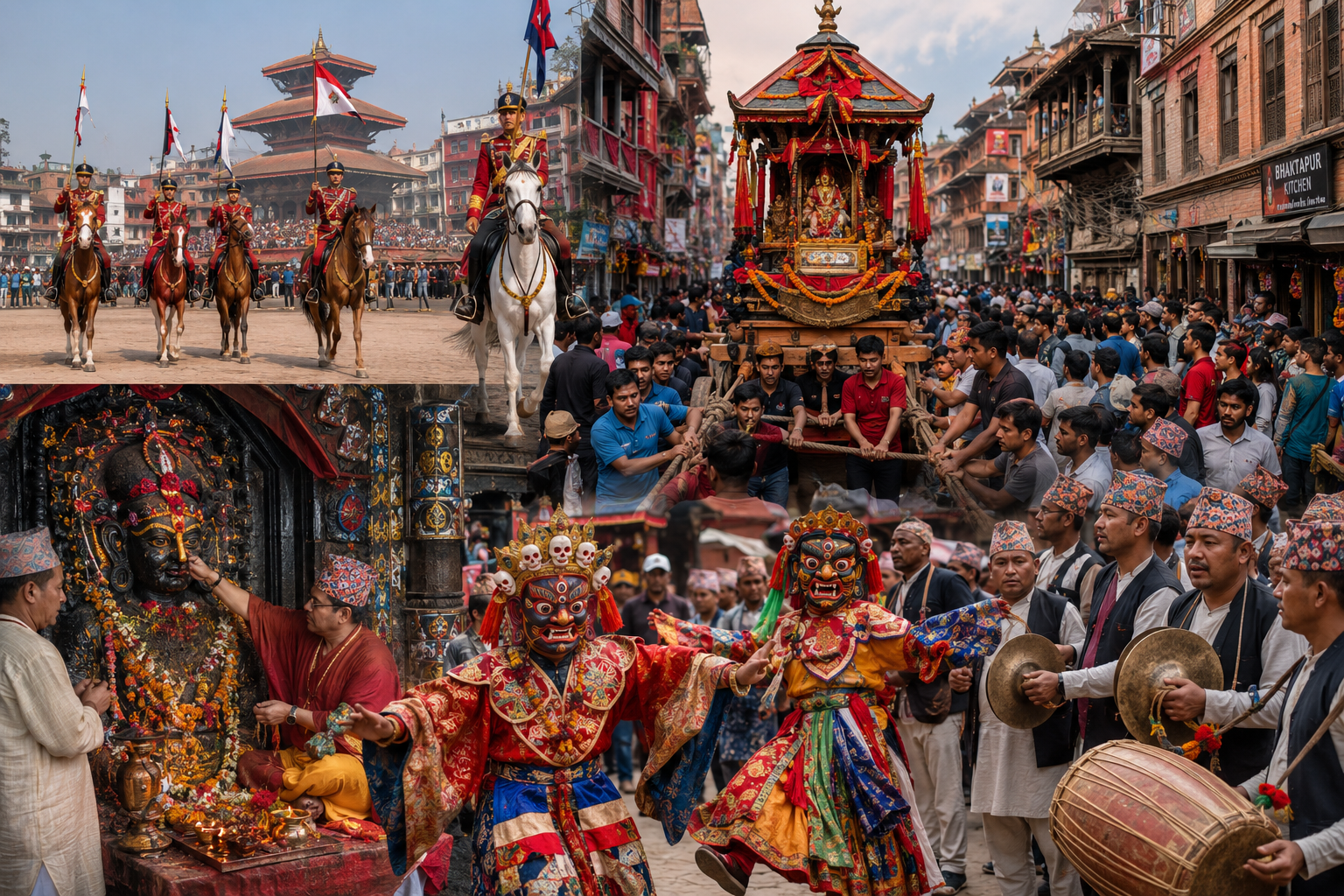
The shocking element of this story is what it reveals about the true nature of Ghode Jatra. The horse parade is not one festival but several festivals happening simultaneously, each belonging to a different layer of the city’s spiritual life. While the Nepal Army gallops across Tundikhel during Ghode Jatra, neighborhood deities are being carried through ancient alleyways in wooden chariots by communities who have performed the same ritual for five hundred years.
If you only watch the horses at Tundikhel, you have seen perhaps half of Ghode Jatra in Nepal. The other half lives in the back streets of Asan and Indrachowk, carried on the shoulders of the faithful, heard in the clashing of cymbals and the tolling of temple bells that echo across the Kathmandu Valley long after the Ghode Jatra horses have stopped running.
Story 5 — The Ghode Jatra That Can Never Be Cancelled
Of all the shocking stories behind Ghode Jatra in Nepal, this one is perhaps the most quietly powerful of them all.
Nepal has survived invasion, civil war, political revolution, devastating earthquakes, and global pandemics. Kingdoms have risen and fallen. Dynasties have been abolished. The political identity of the entire country has been transformed multiple times in living memory.
And through all of it, every earthquake, every revolution, and every upheaval, Ghode Jatra in Nepal has never been canceled.
When hooves strike earth above the old demon’s resting place, light wins again. Beneath the surface, Ghode Jatra speaks to pushing back darkness and keeping harm away from people. Festivals such as Ghode Jatra hold steady when everything else shifts, keeping culture alive through time. These moments hand down ways of life before they fade, linking one age to the next.
Elders warn that if the race is not held, the spirit might rise again to cause havoc.
There is something deeply profound in the unbroken continuity of Ghode Jatra. A city that has buried its fear in the ground and chosen, year after year, century after century, to keep it buried through the act of celebration. Ghode Jatra in Nepal is not just a festival. It is an act of collective will. It is Kathmandu saying, every single spring, “We are still here.” The demon stays down. Ghode Jatra will run.
Why is Ghode Jatra Celebrated — The Complete Answer
Now that the five stories have been told, the question of why Ghode Jatra is celebrated has a layered and deeply human answer that no single legend can fully capture.
To keep the demon underground. The parade of horses at Tundikhel keeps the demon’s spirit away. People believe the faster the horses run during Ghode Jatra, the better Tundi’s spirit is dispelled. Festivals like the Janai Purnima festival in Nepal also reflect the deep spiritual traditions of the country.
To mark the arrival of the New Year. As the New Year approaches in Chaitra Shukla Pratipada, the horse parade of Ghode Jatra serves as a symbolic cleansing to welcome the coming year.
To honor the horse as a symbol of power and dignity. Today, Kathmandu celebrates Ghode Jatra to honor these loyal, swift animals. Whether it is the statues of the Rana rulers or great warriors scattered across the city, the presence of a horse is essential to their grandeur. From Napoleon and Kublai Khan to Jung Bahadur and Mohan Shamsher, the horse represents dignity and power.
To celebrate seasonal transition and community health. The whole thought behind celebrating Ghode Jatra could also be the festival of the adjustment in season. The festivals guarantee good health through the use of nutritious food, and time spent with loved ones makes this day extraordinary.
To reinforce unity across caste and community. Ghode Jatra truly celebrates the unity and diversity within the Newar community. People from different castes and backgrounds join together to participate in the festivities, fostering a sense of harmony and companionship. It is a time for family gatherings, feasting, and reveling in the rich cultural heritage that defines the essence of the Kathmandu Valley.
Every one of these reasons is valid. Every one of them is true. And together, they explain why Ghode Jatra in Nepal has outlasted every king, every dynasty, and every political upheaval that the Kathmandu Valley has ever known. Nepal hosts many major festivals like Ghode Jatra, including the famous Maha Shivaratri festival in Nepal.
How Ghode Jatra is Celebrated Today—What to Expect
The Grand Horse Parade at Tundikhel
The grand horse parade and procession is the central event during the Ghode Jatra festival in Kathmandu. It takes place at the large open ground in Tundikhel. The Nepal Army organizes the parade, showcasing their cavalry skills through precision drills and choreographed routines. About 60 horses participate and perform various moves and stunts. Participants also perform motorcycle performances, rescue exercises, paratrooper displays, acrobatics, and gymnastics. The participants demonstrate their skills in front of high-ranking officials, including the president and prime minister of Nepal.

The presence of the head of state at Ghode Jatra is not purely ceremonial. It is a continuation of a tradition stretching back to the Malla kings, who personally presided over the very first Ghode Jatra in Nepal celebrations at Tundikhel centuries ago.
The Newar Community Feast
Ghode Jatra is a time for family gatherings, feasting, and reveling in the rich cultural heritage that defines the essence of the Kathmandu Valley. For the Newar community, Ghode Jatra in Nepal is as much about the table as the track. Families gather for elaborate traditional feasts, recipes passed down through generations are carefully prepared, and the combination of celebration, seasonal transition, and community connection gives Ghode Jatra a warmth that the military spectacle alone cannot capture.
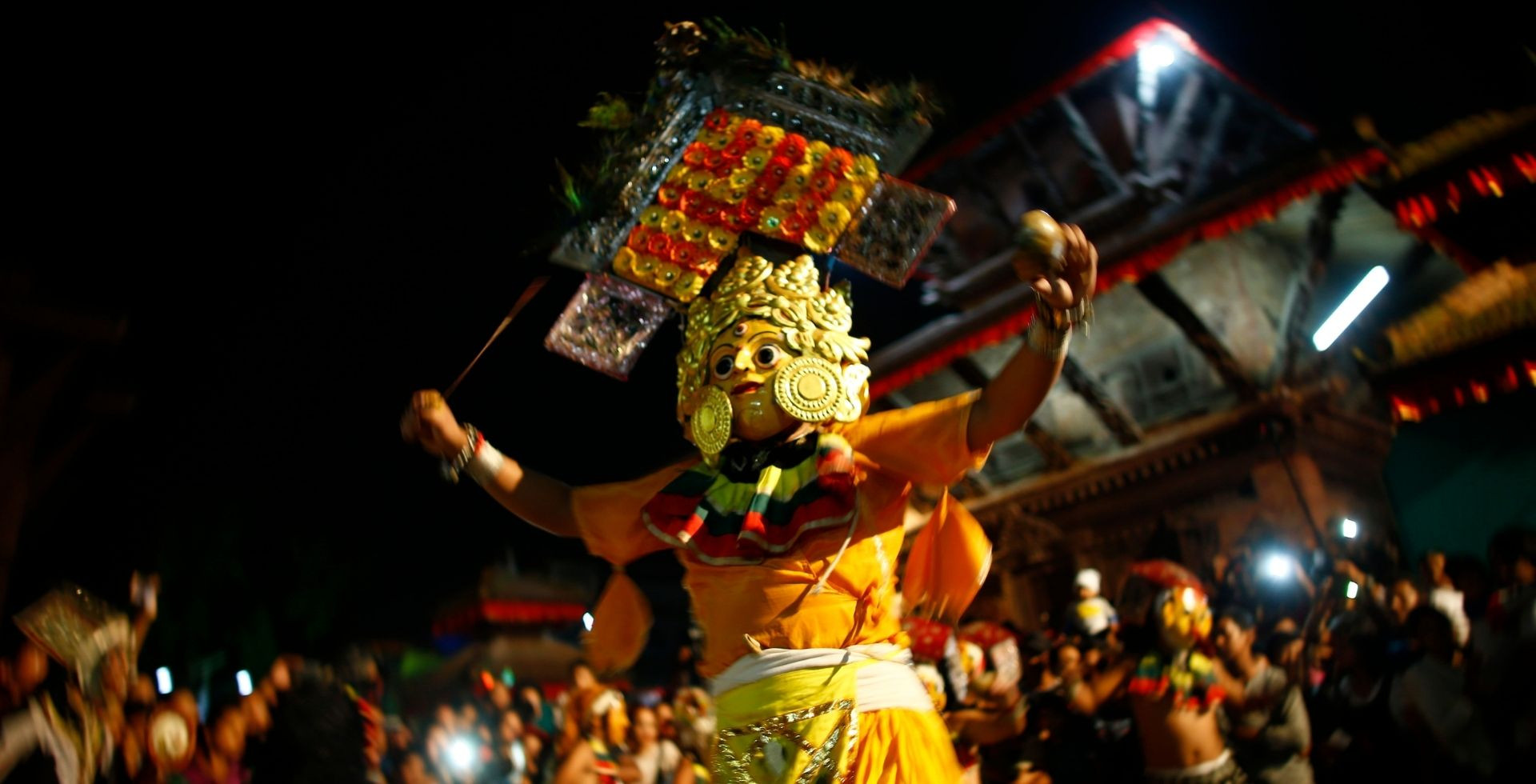
The Chariot Processions of Pahan Charhe
Simultaneously across the old city neighborhoods of Asan, Indrachowk, and Jaisidewal, smaller but deeply significant chariot processions carry neighborhood deities through streets that have not changed in five centuries. The historic streets of Asan and Indrachowk fill with color as beautiful chariot parades of local deities meet in the squares during Ghode Jatra. These processions are the community soul of Ghode Jatra in Nepal, intimate, neighborhood-level, and entirely authentic in a way that no ticketed event ever could be.

The Military Skills Display
The festivities of Ghode Jatra begin early in the morning when the Army offers a sacrifice at the Revanta Pith in Juddha Sadak, signaling the start of the skills display at Tundikhel. The breathtaking equestrian stunts, races, gymnastics, and martial arts performed during Ghode Jatra are the result of months of rigorous practice. What spectators witness at Ghode Jatra is not improvisation—it is the polished result of the Nepal Army’s dedicated preparation, making each Ghode Jatra performance a showcase of discipline that rivals any military parade in the world.

Practical Guide — How to Experience Ghode Jatra in Nepal
Arrive early at Tundikhel. The best viewing positions for Ghode Jatra fill up hours before the parade begins. Visitors are advised to arrive early at Ghode Jatra, as crowds gather rapidly, particularly on the western side of Tundikhel for the best viewing experience.
Get a viewing pass. Foreign visitors attending Ghode Jatra in Nepal can obtain special viewing passes through hotels, tour operators, or the Nepal Tourism Board for closer access to the main parade ground.
Explore beyond Tundikhel. After watching the main Ghode Jatra horse parade, make your way through the back streets of Asan and Indrachowk to witness the Pahan Charhe chariot processions. This is the layer of Ghode Jatra in Nepal that most visitors miss entirely, and it is extraordinary.
Dress appropriately. Ghode Jatra is both a public and religious event. Modest clothing is appropriate, especially when moving through neighborhood temple areas during the chariot processions.
Plan for traffic. If you are traveling around the Tundikhel and Ratnapark areas during Ghode Jatra, be prepared for heavy traffic congestion due to the celebrations. Plan ahead to avoid delays.
Combine with local food. The Newar feast tradition on Ghode Jatra day means that local restaurants and family-run eateries in the old city neighborhoods serve special seasonal dishes. Ask your hotel or guide for recommendations for an authentic taste of how Kathmandu celebrates Ghode Jatra in Nepal. Visitors often combine Ghode Jatra with a Kathmandu World Heritage Tour to explore historic sites.
FAQs About Ghode Jatra in Nepal
Q1. Why is Ghode Jatra celebrated?
It is celebrated to defeat evil spirits, especially the demon Tundi, and to mark the arrival of spring and Nepali New Year.
Q2. What is the history of Ghode Jatra, and who started it?
Ghode Jatra began during the Malla period and is believed to have been started to protect Kathmandu from the demon Tundi.
Q3. When is Ghode Jatra in Nepali date 2083?
Ghode Jatra 2083 falls on Chaitra Aunsi, likely around April 6, 2027 (Gregorian calendar).
Q4. Is Ghode Jatra a public holiday?
Yes, it is a public holiday in the Kathmandu Valley, with government offices and schools closed.
Q5. Where is Ghode Jatra celebrated?
It is mainly celebrated at Tundikhel, Kathmandu, with events also in nearby valley cities.
Q6. Who organizes the Ghode Jatra parade?
The Nepal Army and Nepal Police organize the main horse parade in Tundikhel.
Q7. What happens if Ghode Jatra is not celebrated?
It is believed the demon Gurumapa’s spirit could return, so the festival is never skipped.
Q8. Can tourists attend Ghode Jatra?
Yes, tourists can watch the parade in Kathmandu, often with access through tour operators or hotels.
There are festivals that entertain, festivals that educate, and festivals that carry entire civilizations on their backs. Ghode Jatra in Nepal is all three at once: a thundering military parade, an ancient demon-warding ritual, a community feast, a royal legacy, and a reminder that some stories are too important to ever stop telling. Whether you stand at the edge of Tundikhel as the Ghode Jatra horses gallop past or wander through the lantern-lit alleyways of Asan as the deity chariots roll by, you are not just watching a festival. You are watching Kathmandu remember who it is. And that is what makes Ghode Jatra year after year, century after century, completely unforgettable.

Table of Contents
- Ghode Jatra in Nepal: The Festival That Stops a City in Its Tracks
- What is Ghode Jatra in Nepal?
- When is Ghode Jatra on the Nepali date 2083?
- Ghode Jatra History — Who Started It and Why
- Story 1 — The Demon Buried Alive Under Tundikhel
- Story 2 — The Gambler, the Golden Plate, and the Ghost
- Story 3 — The King Who Weaponized Ghode Jatra
- Story 4 — The Goddess Who Demands to Be Present at Ghode Jatra
- Story 5 — The Ghode Jatra That Can Never Be Cancelled
- Why is Ghode Jatra Celebrated — The Complete Answer
- How Ghode Jatra is Celebrated Today—What to Expect
- Practical Guide — How to Experience Ghode Jatra in Nepal
- FAQs About Ghode Jatra in Nepal

Need Help?
Ask to Travel Expert