
- Mt. Kailash Tour
- Kailash Mansarovar Overland Tour
- Mount Kailash Yatra By Helicopter
- Kailash Yatra via Lucknow
- Kailash Mansarovar Tour via Lhasa
- Kailash Lhasa EBC Tour From Beijing
- Kailash Heli tour via Kerung
- Kailash Tour via Lhasa In Kerung Out
- Lhasa EBC Kailash Tour
- Kailash Heli Tour
- Kailash Mansarovar Yatra
- Kailash Nandi Kora
- Kailash Tour via Humla Simikot – 20 Days
- Mount Kailash Tour : Best Package and Cost for 2025
- Trekking
- Tours
- Outbound
- Activities
- Company
- Travel Info
- Blogs
- Contact


WhatsApp +977-9851035239

Email Us [email protected]
Everest Base Camp Trekking 14 Days



Trip Duration
14 Days
Trip Difficulty
Moderate
Max. Altitude
5,364m. / 17,598ft.
Activity
Trekking, Hiking & Sightseeing
Destination
Nepal
Group Size
2-20 people
Accommodation
Hotel/Guest House as per guests’ choicesHighlights of Everest Base Camp Trekking 14 Days
- The one-of-a-kind scenery of the beautiful Himalayan landscapes.
- Visit the cultural center (Namche Bazaar) and the spiritual center (Tyangboche Monastery).
- Explore Sherpa’s culture, and history, and taste their cuisines.
- See the lovely scenery of several summits like Everest, Lhotse, Choyou, Makalu, and many more.
- Get to see a panoramic view of the Khumbu region Himalayas from Kala Patthar viewpoint.
Price starts
US$ 1400
We offer group discounts
- 1 - 4 personUS$ 1500
- 5 - 10 personUS$ 1400
- 11 over 9999 US$ 1300
Total Cost:
US$ 1500
Need Help? Ask to Travel Expert
Trip Overview of Everest Base Camp Trekking 14 Days
The Everest Base Camp trek is one of the most popular trekking destinations in the world if not, the most popular one. Many individuals from all around the world go on this trek; most make it to the base camp while a few don’t. But they all have one thing in common: it is an unforgettable experience, nevertheless. This trek initially makes you familiar with Mt. Everest and its surroundings but also the Sherpa culture and customs.
If you are visiting Nepal, you are likely to land at the international airport in Kathmandu. The only other route for known access to the Khumbu region is through Tenzing Hilary Airport Lukla. The alternative is traveling to Jiri which can be reached through a bumpy 8-hour long ride.
It is an exciting experience just to get to Lukla where the main trek starts. The 14-day trek to the Everest Base Camp has been described for a long time as one of the best long-distance treks in the world.
Traveling on the track alongside the Dudh Koshi passing through many suspension bridges takes you to Phakding on the second day. The next day (the third day), we will reach Namche Bazaar. Every time a hiker wakes up in this part of the world, there is that sound of the Yak bells that shall keep you company at the Everest base camp.
Development of problems related to altitude illness can occur to anyone regardless of their physique and age. Especially, the possibility of acute mountain sickness which is a frequent phenomenon when traveling in the Himalayan mountains has been known to get the majority of the trekkers. Our body must acclimatize to the altitude of this region; thus, we will spend a whole day acclimatizing at Namche Bazar.
Besides you are going to visit the Monastery at Tengboche situated at the ridge of the mountain which is one of the highest monasteries in the world. The old monastery that represents arts imprinted with the tradition of the country with the panoramic view of the Himalayas is a cultural cum-natural phenomenon.
It is a general rule that at nighttime, the temperature can go down and can become very cold. So, make sure that you use bottles that don’t completely freeze.
The consequences of altitudes as well as thin air alongside night-frost temperatures take a toll on the human body, especially during chilly nights. On the trail, there will be times when one can hardly imagine that you will be at around 4000 m in elevation, and towering above you will be 6000/8000m high mountains.
Lastly, the Everest base camp trekking makes you visit Kalapatthar (5540m) one of the high points of trekking which offers you stunning views of mountains like; Everest, Chyangtse, Nupse, Lhotse, and many more.
Detail Itinerary of Everest Base Camp Trekking 14 Days
Day 01: Arrival at Tribhuvan International Airport in Kathmandu and pick-up at the hotel
On our first day, you will arrive at Kathmandu, the capital city of Nepal, where you will be welcomed and picked up by one of our representatives in a private vehicle. But before you are allowed to leave the airport area, you are required to get your tourist visa.
If you arrive early in the morning then you can explore and enjoy the beautiful culture, heritage, and picturesque scenery of the Kathmandu Valley. We would also like to inform you that during your stay in Kathmandu, we will only provide you breakfast while your other meals will fall at your own expense. But your full-day courses that include breakfast, lunch, and dinner will be provided to you on your trekking days.
Highest Altitude
1300m. (Kathmandu)
Meals
BB
Accommodation
HotelDay 02: Flight from Kathmandu to Lukla and trek to Phakding
On the 2nd day of the Everest Base Camp trek, you will land at the thrilling airport of Lukla. After we are done with the morning meal, we will pack our bags, and leave for the regional airport to get to Lukla.
The airport in Lukla is situated atop a mountain and is highly susceptible to weather conditions, including wind, rain, and clouds. The small, uphill runway is the only place the experienced pilots can make a landing. They aren’t going to fly out from Kathmandu if the weather or other factors aren’t suitable for flying/landing.
As a result, cancellations and delays are likely. If you have to cancel even one flying day, you will lose that entire day, so be careful not to be too tight with your schedule. You can reach Lukla in about 30 minutes on the small aircraft, which has around 18 seats.
On the first day from Lukla, the trail leads downward through the Dudh Koshi River. You will trek along a peaceful, forested route that takes you across suspension bridges with prayer flags. It passes through a section where the traveler is able to get a glimpse of the higher Himalayan range and a view of the authentic centuries-old Sherpa villages. After a few hours of walking, you will arrive in a beautiful village called Phakding. You will check in at a tea house, then continue walking around this very peaceful place.

Activity & Duration
Flight, around 30-minuteHighest Altitude
2610m. (Phakding)Meals
BLDAccommodation
GuesthouseDay 03: Trek to Namche Bazaar
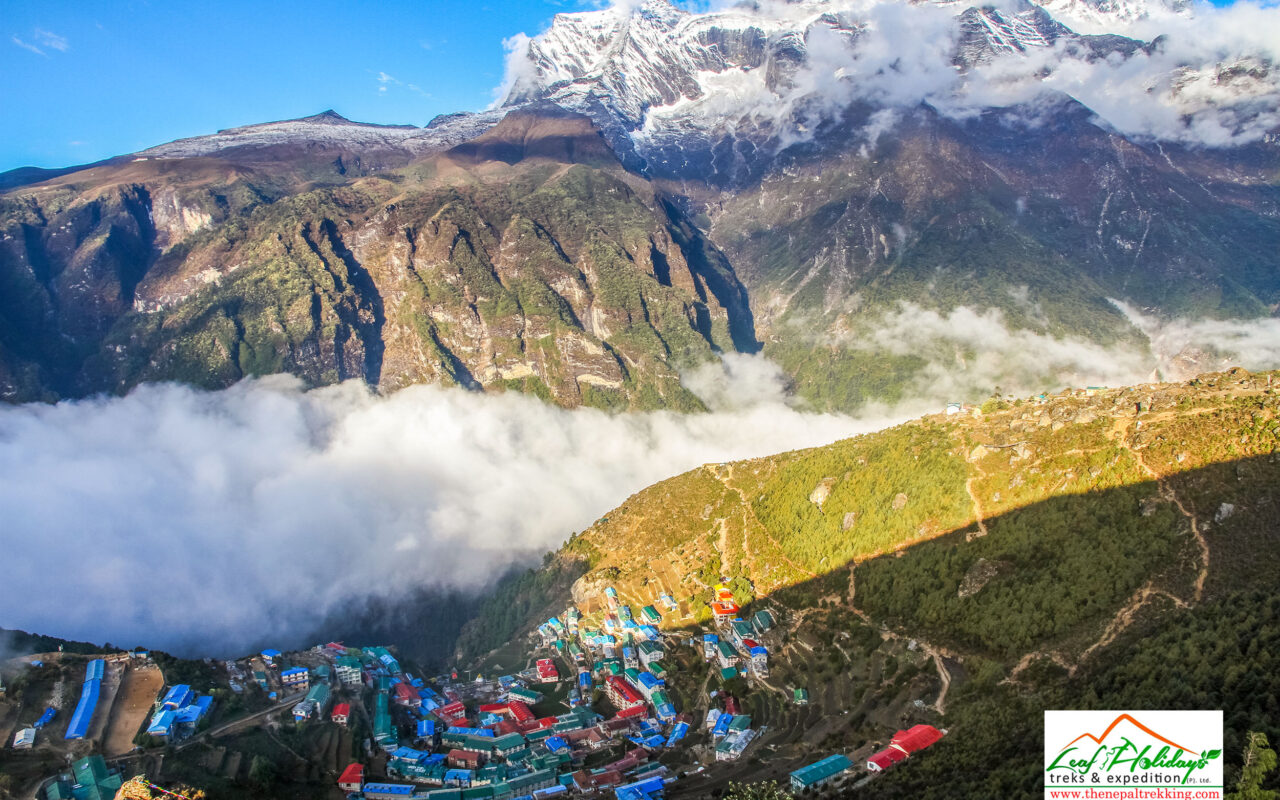
Today’s trek will cover the core of the Khumbu region as we head towards Namche Bazaar, the most beautiful village you will come across during this Everest Base Camp trek. The trail begins with climbing up the steep hill towards Namche, from where it traverses along the banks of the Dudh Koshi River through beautiful pine forests and over suspension bridges. However, before you reach the summit, and for the first time ever, you finally set your eyes on Everest.
Namche Bazaar and viewpoints: After two days of hiking, the trail steepens to join the main Everest trail at Monjo, from where it’s a short trek to Namche Bazaar, a bustling hill town resting atop a bunch of lush hills. Namche Bazaar is more than simply a resting point for trekkers and climbers to obtain supplies, for it boasts numerous establishments, including shops, cafes, and bakeries.
You can spend your extra hours going around the town and have a good time in general. Usually, it is a visit to the local market, communication with friendly local people, and stunning views of the peaks of Kongde Ri and Thamserku.
Activity & Duration
Trekking, 6-7 HoursHighest Altitude
3440m. (Namche Bazaar)Meals
BLDAccommodation
GuesthouseDay 04: Acclimatization day in Namche Bazaar
Acclimatization is very important in order to do a successful trek, especially at high altitudes. Today is considered a rest day to give the body a chance to acclimate to the low density of oxygen present at higher altitudes. Namche is an ideal place for acclimatization, but you can always take a small trek to the Everest View Hotel, which is slightly above the town.
This stunning village also provides a spectacular view of Mount Everest, Lhotse, Ama Dablam, and other majestic mountains. After the day tour to Everest View Hotel, you should head back to your accommodation to spend the night. You can visit monasteries, and museums, or appreciate the environment.
Activity & Duration
Trekking,Highest Altitude
3440m. (Namche Bazaar)Meals
BLDAccommodation
GuesthouseDay 05: Trek from Namche Bazaar to Tyangboche
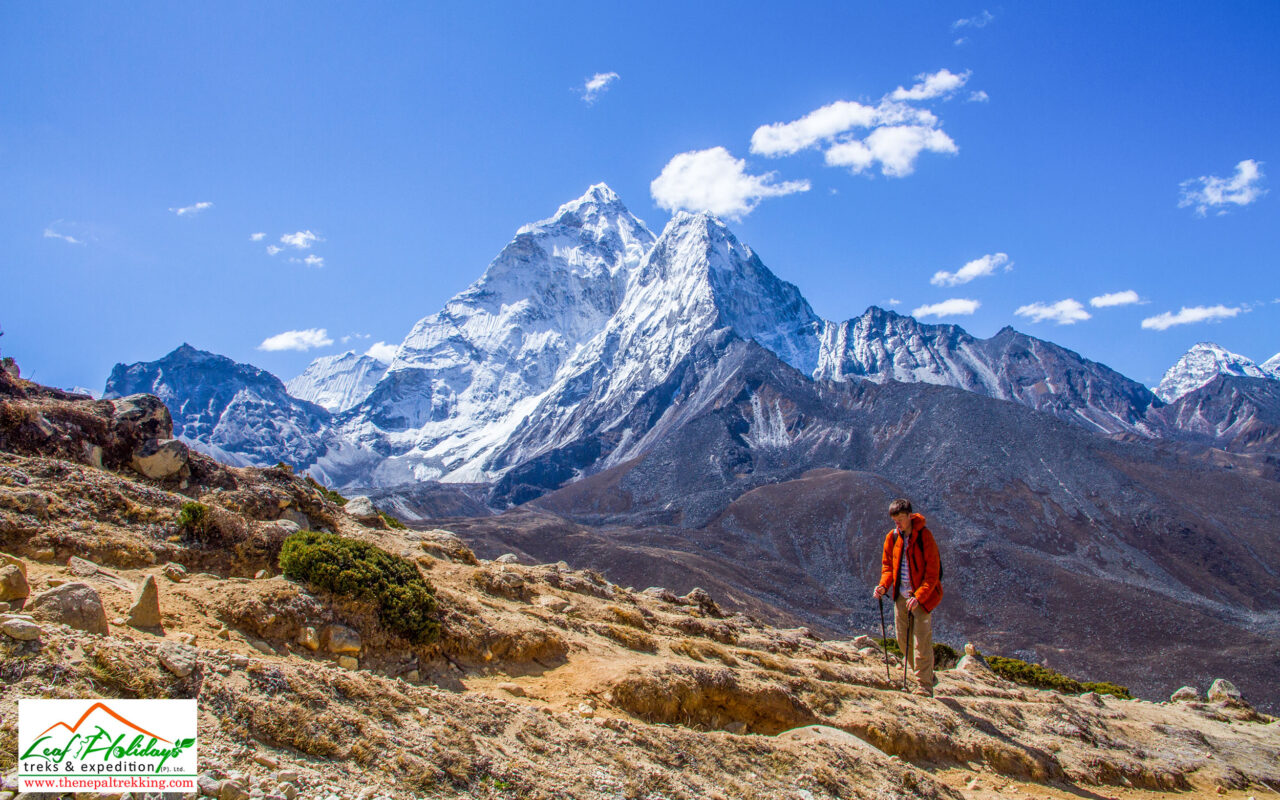
This trek from Namche Bazaar to Tyangboche at a height of 3867 meters will approximately take 5 hours. The trail proceeds and descends from Namche Bazaar by going around the ridges of the valley, from where we get to see the majestic peaks of Mount Everest, Lhotse, and the gigantic Ama Dablam.
You will walk through the rhododendron forest, then you will come to a valley, and passing through the bridge, you will enter the Dudh Koshi River once again.
The trail then again becomes moderate and ascends gradually to the village of Tyangboche with the Tengboche monastery. This spiritual center is surrounded by stunning mountain views, and one gets the sense they are in the middle of nowhere, perfect for introspection and meditation.
Sometimes, you may be lucky if you can get to see the monks chanting and performing their rituals or other ceremonies. I ate breakfast at Phortse village and continued my trek, spending the night at the Tea House in Tyangboche, which was quite serene.
Activity & Duration
Trekking, 3-5 HoursHighest Altitude
3867m. (Tyangboche)Meals
BLDAccommodation
GuesthouseDay 06: Trek from Tengboche to Dingboche (4410 meters)
You get to walk through the alpine meadows and some parts of the green rhododendron forests on your 4th day of the Everest Base Camp trek, against the backdrop of the mighty Himalayas. The trail covers the Chhukung Valley; you will cross some temporary settlements and suspension bridges and cross Imja Khola.
After some time, the terrain starts to change, and as you gain altitude, the surroundings become more desert-like. Dingboche is the place you should aim to visit today, it is an amazing village that is located in the large, flat area of the valley. The trip also provides a magnificent view of the island peak and the other neighboring mountains that have accumulated snow at the peak.
We will trek for eight hours and rest at Dingboche; our trek guide will take you to a tea house for an overnight stay before proceeding to higher altitudes.
Activity & Duration
Trekking, 6 HoursHighest Altitude
4410m. (Dingboche)Meals
BLDAccommodation
GuesthouseDay 07: Trek from Dingboche to Lobuche
The journey from Dingboche to Lobuche can take between four and five hours and reaches an altitude of 4950 meters. When you finally step out of Dingboche, the trek is quite steep, yet the trail offers an excellent view of the Khumbu Glacier and other huge rocky peaks of the Khumbu region. You will go through markers placed along the route in honor of the climbers who perished on the way up to Everest. As unfortunate as it is, this will be a morale booster for the harshness that you will endure.
This trail then takes you through to Lobuche, a small point nestled at the base of the Khumbu Glacier. It is early in the trek, and the altitude is much higher at Lobuche, so please do not exert yourself too much and remember to drink plenty of water.
The excellent backdrop adds Lhotse Shar, Nuptse, and Pumori, which rise vertically and majestically behind Everest. After reaching our destination of the day, we spend the night at a tea house in Lobuche and prepare for the next day’s trek.
Activity & Duration
Trekking, 5 HoursHighest Altitude
4940m. (Lobuche)Meals
BLDAccommodation
GuesthouseDay 08: Trek from Lobuche (4,950 m) to Gorakshep – Everest Base Camp (5364 m) then return to Gorakshep
From Lobuche to Gorak Shep to Everest Base Camp and back to Gorak Shep, it takes around 7-8 hours. It’s a demanding but fulfilling day ahead as you hike to the famous Everest Base Camp. It weaves along the Khumbu glacier, and the whole atmosphere is dominating as you reach higher ground.
From Kala Patthar to the Base Camp, the landscape is quite rocky, but then there are also glacier tracks, and finally, after those few hours of climbing, trekkers get the feeling of having achieved something great when the Base Camp comes into view.
Activity & Duration
Trekking,Highest Altitude
5364m. (Everest Base Camp )Meals
BLDAccommodation
GuesthouseDay 09: Ascend to Kalapathar (5,644m) & return to Pheriche (4,371 m) 8-9 hours trek.
Your ascent to the Kala Paththar will take two to three hours and we will move early in the morning. It will be a delightful morning to view the dawn amid other peaks in the shadow of the Himalayas.
Mount Lingtren (6697 m), Mount Pumori (7145 m), Mount Changtse (7550 m), Mount Khumbutse (6623 m), Mount Lhotse (8516 m), Mount Cho Oyo (8201 m) in the west, Mount Nuptse (7861 m), and other trivial peaks will keep your vision too occupied to keep track of the peaks of the mountains encircling Kala Paththar. After breakfast, you will return to Gorak Shep and go to Pheriche.
March to May and September to November are the best times of year for hiking to the amazing viewpoint of Kala Patthar. Warm temperatures, excellent visibility, typically stable weather, and very little rainfall are all present during these months. The ideal season, however, really depends on your preferences.
Please keep in mind that up in mountainous areas, the sun and wind are important aspects to take into account. If it becomes gloomy and windy, a day that appears to be bright and sunny can rapidly turn into an unbearably cold one.
Put on an adequate windcheater and some additional warm clothing in preparation. Additionally, keep in mind to use sunscreen and high-quality eyewear to shield both your eyes and your skin.
The majority of the trek is downhill, and the breeze increases as you descend from Thukla Pass to Pheriche Village, so packing windbreakers for the day is a great idea. Since this is the first session of the downhill trek, wear knee pads if you have any issues with your knees. Also, let your trek leader know if you need any help.
Thukla Pass offers a great scene of the river valley and after you reach the river valley you can enjoy a picturesque scene of the Pheriche village, our destination of the day.
Activity & Duration
Trekking, 7-8 HoursHighest Altitude
5644m. (Kalapathar)Meals
BLDAccommodation
GuesthouseDay 10: Pheriche-Pangboche-Kyangjuma [3,550 m/11,280 ft]: 6 -7 hrs
Today is a fantastic hiking day. The hike leaves Pheriche at around seven in the morning. We feel like we’re ready to take off for a lower altitude today, so we will begin the trek in the morning. After a hearty breakfast, we will start early because we want to arrive at Kyangjuma with plenty of spare hours. The last upper part before Tengboche and after Phungi Tenga becomes more challenging to hike as the day wears on.
Starting from Pheriche, the trail follows a river throughout a plain that is level and divided into valleys. The trail starts to climb after more than thirty minutes of walking. After that, the trail descends sharply for another hour till it reaches Syomare.
Once more, you will need to go directly uphill to reach Pangboche after Syomare. It’s a well-known spot to take a quick break. Since you’ve been walking for hours straight and are feeling tired, try some tea or coffee.
Following your tea, this trail only keeps going downhill until the river crossing. You will slowly get into a forest as you travel down this route. Steer clear of slick areas and place your foot on solid ground. From there, it’s all downhill for almost an hour until you get to Dobuche. The trail then climbs for a further hour to reach Tengboche where we will have our lunch.
Following an hour-long lunch break, you will need to descend till you arrive at Phungi Tenga. You have to trek up into the wooded areas of rhododendrons once more. After about half an hour of gentle walking with only a few ups and downs, the trail begins to climb into a forest. The ascent would take about 1.5 hours to reach Kyangjuma. a charming tiny village featuring a bakery and a few tea houses and lodges. It’s quieter and less crowded with tourists.
Activity & Duration
Trekking, 6-7 hoursHighest Altitude
3550m. (Kyangjuma)Meals
BLDAccommodation
GuesthouseDay 11: Trek from Kyangjuma to Monjo
This trek from Kyangjuma to Monja, at a height of 2850 meters, will take about five to six hours. We will start our 8-kilometer trek by descending to the Dudh Koshi River. After some time of going downward from the hills, we will reach a foothill. From there, we will head right over the bridge, which is quite thrilling, to the other side of the river.
The trail from the suspension bridge continues going upward, passing through many green forests, rhododendron forests, and pine forests. You will also get some time to enjoy the most beautiful scenery of the river, mountains, and summits.
After some uphill walking, we will reach Namche Bazaar, which is a vibrant Sherpa-dominated town and an important center for trekkers in the region. Here, we will ease off of our tiredness and begin our strolling around the beautiful town, as well as use the chance to restock if necessary.
We will continue walking on the main trail that takes us downward, this time towards the Dudh Koshi River, after leaving Namche Bazaar. We will walk through several different villages and a couple of suspension bridges on the way to finally reach Monjo, a small village situated in the Himalayan region of about 2835 meters (9301 ft) above sea level. This is where we will enter Sagarmatha National Park and present our permits at the checkpost before proceeding to leave the area.
Activity & Duration
Trekking, 5-6 HoursHighest Altitude
2835m. (Monjo)Meals
BLDAccommodation
GuesthouseDay 12: Trek from Monjo to Lukla
This will be the last trekking day of our Everest Base Camp trek. We will continue our journey of 5-6 hours trek, early in the morning after spending a night at Monjo. We will move downhill to Phakding, which is at an elevation of approximately 8530 ft. We will also encounter several suspension bridges during our journey to Lukla just like we did yesterday.
Carrying on from Phakding, we will come across Chheplung and Thado Koshi, which are two lesser-known villages on the trail. These villages are beautiful, offer visitors an excellent view of the mountains within the region, and are perfect even for short trips to the hills.
Then, we will be moving with a slow, steep rise from Thado Koshi, from where we will arrive at Lukla. This place is a rapidly developing town and is the starting point for the Mount Everest region. It is also home to Tenzing-Hillary Airport, which is rated among the world’s most dangerous airports because of the massive mountains and the short runway that makes both take-off and landing difficult.
Activity & Duration
Trekking, 4-5 HoursHighest Altitude
2860m. (Lukla)Meals
BLDAccommodation
GuesthouseDay 13: Lukla – Kathmandu
Day 13 will be your final day in the hills of Nepal. Once you are done with your breakfast, we will move towards the airport, remembering all the memories we made in this Everest Base Camp trek. It will be hard for us to leave this amazing land full of nature but we have to make it happen.
Throughout the scenic flight back to Kathmandu, you will find yourself gazing at the hills and mountains for one last time.
Activity & Duration
Flight, around 30 minutes.Highest Altitude
1300m. (Kathamndu)Meals
DAccommodation
HotelDay 14: Departure to international airport
The following day, one of our reps will make sure that you reach the Tribhuvan International Airport on time. This will be your last day in Nepal.
Highest Altitude
1300m. (Kathmandu)Meals
BAccommodation
HotelIncludes and Excludes
What is included?
- Pickup and drop at airport by private car
- Two-night hotel stay in Kathmandu on B/B plan
- 11-night Tea houses accommodation during the trek
- Airfare for Kathmandu-Lukla-Kathmandu including airport tax
- Kathmandu Valley Sightseeing Tour inclusive of guide and transportation
- Government license holder English speaking guide
- Porter to carry your baggage
- Food, drinks, accommodation, insurance, equipment, Transportation and local tax for guides and porters
- All ground transportation charges
- TIMS card (Trekker’s Information Management System)
- National Park Trekking Permits
- Medical kit (carried by your tour guide)
- Leaf Holidays t-shirt and duffel bag
- Travel and rescue arrangement
- All government paperwork, VAT, taxes and service charges
- Traditional Nepali cultural farewell dinner
What is excluded?
- Lunch and dinner in Kathmandu
- Drinks
- Food during the trekking (unless the second option is purchased)
- Travel insurance
- Visas
- Tips for trekking staffs
- All items not listed in cost inclusive sectio
Trip Information
How does our trip start?
We travel to Lukla, the entry point to Everest, via plane after touring the temples, shrines, and marke, in Kathmandu. After that, we ascend to the Dudh Kosi Valley, which is encircled by the stunning peaks of Thamserku and Kusum Kanguru. We climb steeply to Namche Bazaar, the Khumbu capital, and then spend a day exploring and getting used to the altitude.
From there, we take the routes up to Tengboche, sitting atop a ridge and offering one of the world’s greatest 360-degree views of mountains. Ama Dablam, Kantega, the Lhotse-Nuptse Wall, and Everest are all visible. The huge size of Mount Everest itself looms closer and closer as we pass by old shrines and Buddhist temples.
Difficulty
We must consider the challenges in a larger context. Perhaps because of its popularity, people believe that the Everest Base Camp is the most difficult route Nepal offers. In actuality, Nepal offers a lot more strenuous trekking options than just the Everest Base Camp. This hike is probably a moderately challenging one. That is not to imply that it is a walk in a park; it’s far from it.
The hike from Lukla to Everest Base Camp is roughly 65 kilometers, which may not seem like much more than a few kilometers over six days of ascending, but other challenges, including altitude and weather, will make the walk more challenging than it would be. This is where the actual difficulties are.
Best seasons
In the Himalayas of Nepal, there are two primary trekking seasons to reach Everest Base Camp. Late March to May is the initial time of year, while late September to November is the subsequent one. The primary monsoon season is effectively straddled by both high seasons, which provide greater dryness and greater visibility without excessive rainfall. It’s crucial to remember that at this elevation, though, there is rarely a guarantee of 0% rain.
The official trekking season begins in March, albeit it hasn’t reached its pinnacle yet. This indicates a decent mix of more affordable prices, an abundance of teahouses, and fewer crowds. By now, the majority of the soil’s snow is gone, but because of the rising temperatures, there may occasionally be heat haze that blocks off the view.
In September, a few days of rain may persist since it is the first month following the monsoon. That being said, it also implies the lower altitude portions of the trip between Namche village and Lukla are incredibly lush, with vibrant vegetation and flowers blooming.
Can a beginner join this trip?
No, a beginner should not join this trip. The Everest Base Camp trek is a 130 km long journey through the hills and rugged trails. This trip may be generally divided into 13–16 km daily pieces. However, because of the height, the adventure must be divided into manageable chunks with acclimatization periods included.
This is why the entire journey takes so many days and is not a beginner-friendly trek at all. The majority of itineraries will allow ample time to finish each leg at a pace far slower than the typical hiker on any given day.
The majority of trekkers find it possible to hike for little more than eight hours a day, however, that number may increase slightly as you approach the route’s higher altitude portions because you’ll find yourself stopping frequently to take in the beautiful sights in addition to the physical struggle.
Altitude Sickness
The risk of altitude sickness starts after you reach an altitude of 5,000 meters above sea level. Although altitude sickness can also occur once you reach 3500 meters of altitude, it is not a serious case to be worried about at that level. But at 5000 meters of altitude, altitude sickness can get dangerous and force you to leave the trek early.
To prevent this from happening, we have included an acclimatization day at Namche Bazar. You will be staying there for a whole day, allowing your body to get used to the environmental factors of the highlands. Scientifically speaking, the causes of altitude sickness are barely studied and explored, however, it has been proven that having a rest day can help people avoid this mishap.
Accommodation, Food, and Drink
Nepal’s most well-known tea house trekking area is the Everest Trek. Let us first define this word in case you are unfamiliar with it. A tea house is a type of lodging constructed for trekkers by the Sherpa inhabitants of Everest. These budget accommodations include a mattress, pillows, a tiny blanket, and two single beds in each room.
Still, businessmen are constructing tea houses in this area due to the rise in hikers. The lovely Sherpa people who own the local establishments are all dedicated to creating environmentally conscious and enjoyable tourism on Everest, which is why they have built a cozy Everest Base Camp lodging.
You spend your nights having dinner and breakfast in the tea houses at the Everest Base Camp trek. You can only choose to eat meals in the tea houses where you are staying, as per the practice. This is done because the rooms are provided at a minimal fee and the only other way for the tea house owner to make some profit is by providing food for the guests.
During your trek in the Everest region, a range of Indian, Chinese, and other cuisines are available. For them to prepare your food in time, you must order your preferred dishes as early as possible. Usually, you should order your dinner right after you reach your destination of the day and your breakfast must be ordered before you head for bed.
Dal Bhat, a meal that combines steaming rice, veggie curry, and lentil soup, is the most well-liked and readily available dish. There’s always something to eat or snack on, you can get yourself instant noodles, different kinds of soups, spaghetti, rice, pizza, and sandwiches.
As for drinks, you can get yourself authentic coffee drinks, different types of beers, juices, and cold drinks at Namche Bazar. However, as you trek up the trail these drinks are hard to come by. Our Everest Base Camp trek will cover all your accommodation and food expenses but we will not pay for any kind of drinks or beverages.
Transportation
Our Everest Base Camp trek package includes transport services such as pick up and drop off at the international airport in Kathmandu, flight to and from Lukla, and pick up and drop at the regional airport. All of these transportation are covered by the Everest Base Camp trek package, you won’t have to pay anything extra for these.
Permit
All hikers in the Everest region must have an entry permit for Sagarmatha National Park. The Sagarmatha National Park entrance gate in Monjo or the Nepal Tourism Board station in Kathmandu are the places where you can get the Sagarmatha National Park entry permit. For most international tourists, the permit costs NPR 3,000; for trekkers from SAARC countries, it costs NPR 1,500.
A permit from the Khumbu Pasang Lhamu Rural Municipality is needed for any hiker who wants to go into the Khumbu region. The Khumbu Pasang Lhamu Rural Municipality Permit is available at the Monjo checkpoint or at the Nepal Tourism Board headquarters in Kathmandu. Each person must pay NPR 2,000 for the permit.
Trip preparation and fitness
On the other hand, occasionally people accompany our trekking groups who don’t think it’s important to prepare for the Everest Base Camp trek, which is a mistake. We frequently hear people informing us that their bodies are not physically fit enough to hike to Everest Base Camp.
You must prepare for this adventure because it will determine how well you do and the group’s overall performance. This is not an athletic trek, but it does need you to commit to as much as ten hours of training per week during the three months before the scheduled trek. The process will go more smoothly and pleasurably the more athletic you are.
Alternative routes
For those who wish to hike the less-traveled paths in the Everest region, the Gokyo and Renjo La route is an ideal alternative. Fewer than 10% of hikers in the Everest region choose to ascend the Gokyo Valley, a high Himalayan location that offers distinct views of Mount Everest, the tallest mountain in the world.
Other trekkers frequently choose the Annapurna Circuit route because of the amazing vistas found along the way. The Annapurna Dhaulagiri circuit offers a different perspective on the area’s elegance, keeping trekkers separated from one another even though it still ventures deep into the Himalayan region.
Gadgets charging & Internet
The tea house’s dining hall is a convenient place to charge electronics. Having a power bank with you will make it easier to charge your devices while you are at rest in tea houses. The cost of charging each device in Namche, Phakding, and Lukla will be NRS 100. Likewise, following Namche, in Tengboche, Dingboche, Lobuche, Gorekshep, Pheriche, and other locations, you need to pay NRS 300 to charge each device.
The majority of locations will have dependable Internet connectivity for you. Internet connectivity is available at many of the lodges along our trekking routes, but usage is chargeable. While coverage varies on different hikes, it is generally reasonable albeit slow in Nepal’s trekking destinations.
What is included in the package?
As a part of the Everest Base Camp trek, we offer a range of services for your convenience. Starting the journey, we will pick you up from the airport and escort you to your designated 3-star accommodation. Every bit of your accommodation will be covered by the trek package.
Your flight expense from Kathmandu to Lukla will also be covered by the Everest Base Camp trek package along with 3 meals per day (breakfast, lunch, and dinner) during the trekking days. To ensure a smooth experience, we will provide your group with a government-licensed English-speaking guide and every two members of the group will share a single strong porter.
The permits required for you to enter the protected region of Khumbu will also be covered by this trek package. In addition, we will also provide you with a first-aid kit and cover all the government taxes.
Your Extra expenses
Lunch and dinner in Kathmandu (breakfast will be provided by us), any kind of drinks/beverages, travel insurance, medical insurance, visa fees, tips for the crew members,
What to expect
The Everest Base Camp trek is perhaps the most well-known journey in Asia if not the entire world. Some individuals argue that the trek’s growing appeal is its own greatest enemy, and it appears that the route has experienced substantial environmental damage and congestion in the past few years.
Nothing, nevertheless, can match the adrenaline rush of adventure that accompanies ascending to the rim of the tallest mountain in the world. This intensifies during the first few days of your trek when you may have stunning scenes of Mount Everest’s backside from an observation platform on the southern flank of Ama Dablam.
The teahouses in the mountains will be the focal point of your daily schedule. They vary from location to location, but in general, they’re a shared dining room that has several bedrooms sharing a communal bathroom. Most tea shops will have shared restrooms; if you’re lucky, you might even get an attached bathroom.
To cook and serve food at a set time efficiently, meals are ordered in advance (based on the menu provided). As a result, you’ll often be placing your morning meal order before bedtime and your dinner order almost as soon as you reach the destination of the day.
Frequently Asked Questions
How long is the trek to EBC?
EBC is an amazing route that takes a fair amount of time to acclimate. Usually, it takes 12–14 days of intense trekking (yes, you have to trek during your rest days as well) to cover the 130 km round trip, which begins in Lukla.
How do I book a trek?
You can simply click on the “book” option. You will have to pay 20% (per person) of the full payment to book a trek for with us. This is a standard practice that allows us to start working on your travel adventure.
Can the trip be customized?
Sure, the trip is flexible and can be modified but you will have to work it out with our trek guide before making your advance payment of 20%. We will provide you with a list of alternative itineraries or possible destinations we can visit along the way.
Is this a safe trek?
To ensure you do not get altitude sick, we include an acclimatization day so that your body adapts to the changing exterior factors of the Himalayas.
Can vegetarian and vegan diets be arranged for?
Yes, vegetarian and vegan diets are manageable. We recommend every traveler to stick to a vegetarian diet as meat in these regions can often cause food poisoning.
Trip Reviews
Price starts
US$ 1400
Need Help? Ask to Travel Expert