
- Mt. Kailash Tour
- Kailash Mansarovar Overland Tour
- Mount Kailash Yatra By Helicopter
- Kailash Yatra via Lucknow
- Kailash Mansarovar Tour via Lhasa
- Kailash Lhasa EBC Tour From Beijing
- Kailash Heli tour via Kerung
- Kailash Tour via Lhasa In Kerung Out
- Lhasa EBC Kailash Tour
- Kailash Heli Tour
- Kailash Mansarovar Yatra
- Kailash Nandi Kora
- Kailash Tour via Humla Simikot – 20 Days
- Mount Kailash Tour : Best Package and Cost for 2025
- Trekking
- Tours
- Outbound
- Activities
- Company
- Travel Info
- Blogs
- Contact


WhatsApp +977-9851035239

Email Us [email protected]
Best Time For Kailash Mansarovar Yatra
14 December 2025 By Leaf Holidays
Mount Kailash and Mansarovar Lake are two of the most sacred pilgrimage destinations in the world. Hundreds of pilgrims visit these places every year, and thousands of people dream of visiting these two places at least once in their lifetime. Unfortunately, you cannot visit Kailash Mansarovar throughout the year. In this blog, we will share with you the best time for Kailash Mansarovar Yatra.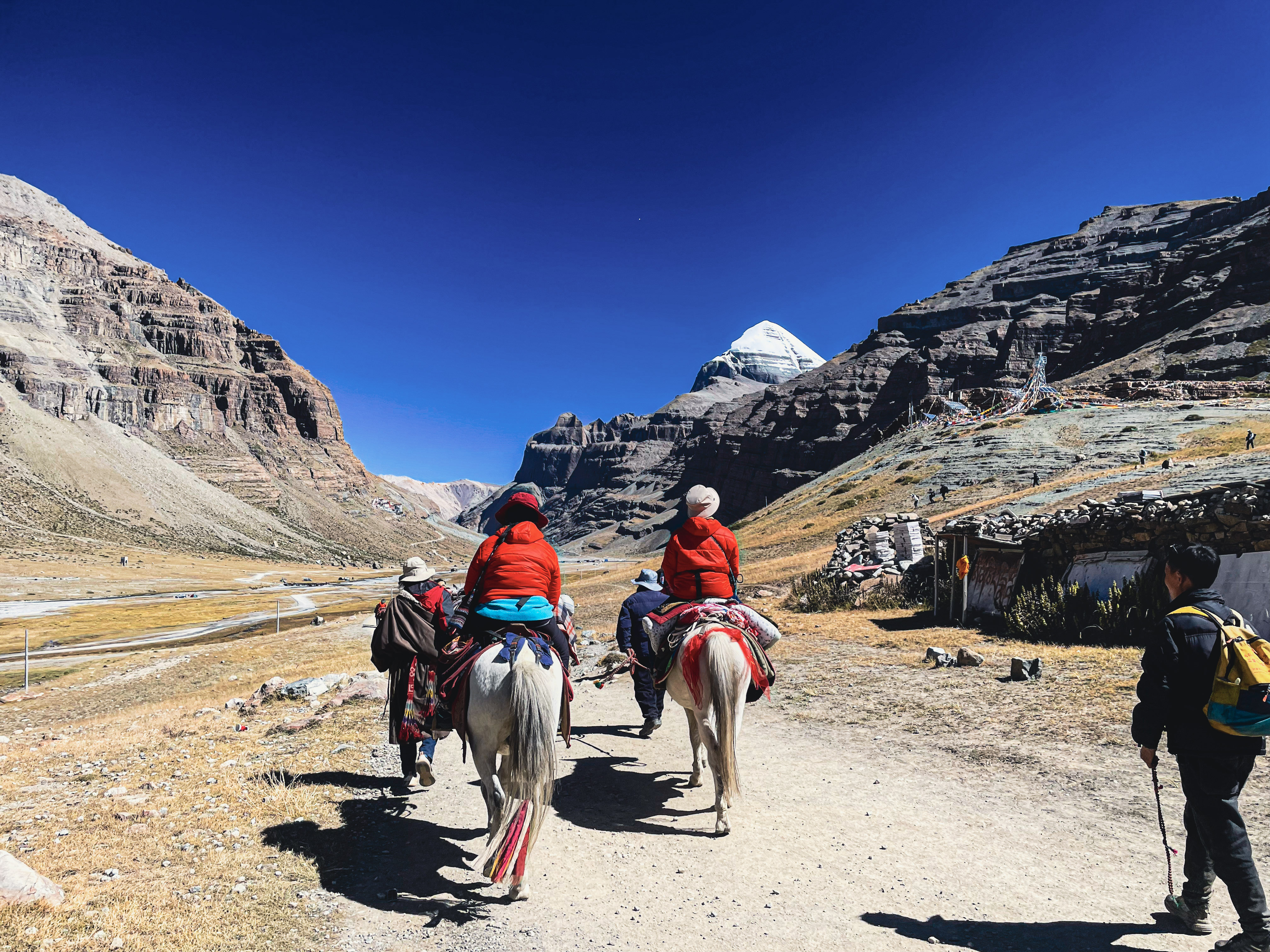
Kailash Mansarovar Yatra best time
The best time for Kailash Mansarovar Yatra is between May and October every year. So, you can only do this Yatra in May, June, July, August, September, and October. The route remains closed in other months due to unfavorable weather and road conditions.
Kailash is situated in the Himalayan region. It is also a high-altitude journey. The weather and climate are only stable between May and October in this area. You might be wondering about the monsoon period then.
July and August are the peak monsoon period. Mansarovar Lake and Mt. Kailash are situated in the western part of Tibet. It only sees intermittent rain. The trails do not get muddy and messy. In fact, the light rain will make the surroundings mysterious and heavenly.
Best time to visit Kailash Mansarovar- monthly guide
Every month brings something different with it, weather, climate, temperature, crowd, and experience-wise.
May – season opening
The Kailash Mansarovar route officially opens for tourists from all around the world in May. If you want to be the first to visit Kailash or wish to escape the overwhelming crowd of pilgrims, consider doing the Kailash Mansarovar Yatra in May.
There is no crowd, and the hotels have just come into business, so you will get the finest service. With the start of May, chilly air gradually settles down, and the icy trails begin to melt.
All the highland routes of Tibet are open, so you can travel to Kailash Mansarovar from Lhara or via Kathmandu-Kerung. Helicopter flights also come into business.
By the end of May, most of the snow has melted. It makes the rivers and streams flow with water, and the greenery comes into life. The climate is warm by mid-May, so senior citizens can travel comfortably.
The Saga Dawa festival on the 31st of May makes this month even more special. But around the festival, the crowd will increase.
June – ideal clear skies
June has the ideal clear skies, so the mountain vistas and landscapes are breathtaking in this month. With the beginning of June, the temperature gets perfect. The daytime is warm, with evenings and mornings on the bit chilly side.
Again, June is the perfect time of the year to do the Kailash Mansarovar Yatra if you are sensitive to cold. It is the warmest time of the year in Kailash Mansarovar.
The route is safer in June. All snow melts, so roads and the Kailash Kora trail become stable and sturdy. The Saga Dawa festival energy surrounds the environment, and pilgrims from all around the world gather in Kailash Mansarovar.
June is a lovely month with excellent weather, warm climate, and festive energy. Towards the end of June, there can be occasional rainfall as the monsoon season is just on the way.
The landscape is at its peak of greenery in June.
July to August – monsoon, but still popular
July and August are the peak monsoon period weather-wise in countries like Nepal, India, Tibet, China, etc. However, around Kailash Mansarovar, the monsoon is not as crazy as in other places.
The Kailash Mansarovar is situated in the rain shadow area of the Himalayas. It means the area receives significantly less rainfall even during the peak monsoon months (June to August).
When the southern part of Tibet sees heavy rainfall, the western areas remain dry with only occasional light rain. So, you can do the Kailash Mansarovar in the monsoon without any worries.
While traveling from India, Nepal, China, or other countries, you will experience heavy rainfall. But once you enter the Kailash area, the weather will stabilize with little to no trace of rain.
If you do the Kailash Mansarovar Yatra via Lhasa, you will experience rainfall in Lhasa and Shigatse, but not once you go higher.
July to August is also a famous time for the Kailash Mansarovar Yatra pilgrimage-wise. Most pilgrims, especially Hindus, do the Kailash Mansarovar Yatra in July and August. These months have Hindu festivals and a full moon period, which makes doing Kailash kora popular.
Light rainfall creates magical foggy scenery. It makes the Kailash Mansarovar Yatra mystical.
September – the most pleasant time of the year
September is often praised as one of the most pleasant times of the year for the Kailash Mansarovar Yatra. After the peak pilgrimage period, September brings peace and stability.
The pilgrimage rush gets low in September. The post-monsoon period brings crisp air, clean sky, and golden autumn landscapes. You will see the unbelievable beauty of Kailash and Mansarovar.
September is great for photography in Kailash. There will be a good number of people, but the crowd is less than in July and August. By the end of September, the climate begins to cool down, and daylight hours get shorter.
October – close of season
With October comes the end of the Kailash Mansarovar Yatra. The crowd gets significantly low. Most pilgrims have already returned, so you will mostly see adventure seekers and nature lovers.
The climate is colder than it was in the last three months. Mountain views and landscapes are still spectacular, but the air gets cold. By mid-October, the region begins to get empty, and snowfall may start at the end of October.
As October comes to an end, the Kailash Mansarovar Yatra season comes to an end. If you want to skip the crowd, October is a great time for the Kailash Mansarovar Yatra.
Kailash Mansarovar Yatra weather in different months
Below, we have made a table with the minimum and maximum temperatures and other details in the best Kailash Mansarovar Yatra months:
| Month | Maximum temperature (℃) | Minimum temperature (℃) | Rainfall (mm) |
| May | 7.1 | -6.8 | 21 |
| June | 11.3 | -1.9 | 32 |
| July | 12 | 1 | 107 |
| August | 11.3 | 0.8 | 119 |
| September | 8.8 | -2.8 | 54 |
| October | 3.7 | -9.8 | 24 |
What makes 2026 the best year for the Kailash Mansarovar Yatra
As per the Chinese Zodiac, 2026 is going to be the Horse Year (specifically Fire Horse Year). The Horse Year comes every 12 years.
The last Horse Year was in 2014. So, 2026 is going to be exceptionally auspicious.
It is believed that one Kailash Kora in 2026 will be equivalent to 12 Kailash Koras. In short, your prayers will be 12 times stronger.
Best time for Kailash Mansarovar Yatra based on purpose
For Pilgrims:
- 31st May is a very auspicious time to be at Kailash Mansarovar. It is the day of the Saga Dawa festival.
- The whole of June, July, and August is the best time for Kailash Mansarovar Yatra. It is the top three months when Hindu devotees do this sacred yatra.
For weather and photography:
- Weather-wise, May, June, and late September have the brightest skies. The views will be clear, and the climate will be pleasant in these months.
- Good weather means you will also get to capture the finest pictures of Mansarovar Lake and Mt. Kailash.
- Similarly, if you wish to capture the Saga Dawa festival or pilgrims, travel according to that.
For Kailash Kora (Parikrama):
- You need stable weather to have the best Kailash Kora experience. For that, June and early September are top choices.
For senior citizens:
- The Kailash Mansarovar area remains cold throughout the year. However, some months are less cold than others. Senior citizens can be highly sensitive to cold climates, so it is best if they do the Kailash Mansarovar Yatra during warm temperatures. Mid-May to July will be the best time for them.
Kailash Mansarovar Yatra routes & when they operate
You can do the Kailash Mansarovar Yatra in 2026 in different ways.
These are the top four routes for Kailash Mansarovar Yatra, and all three of them are operated between May and October. In other months, all routes to Kailash Mansarovar remain closed.
How weather affects the Kailash Kora (Parikarma)
Kailash Mansarovar is situated in the Ngari region. The Ngari region (Ngari Plateau) is the westernmost, highest, and remotest part of Tibet, famously known as the “Roof of the World”. In this region, you will be at a high altitude and experience mountain climate.
Many pilgrims do not realize that Kailash Kora is not like the usual circumambulation around a sacred landmark. During the Kora, you will be at an average elevation of around 4,700 to 5,000 meters, and the highest point will take you to 5,630 meters (Dolma La Pass) above sea level.
Walking at this altitude on rough terrain and in a cold climate is not easy. It tests your endurance and willpower. If the weather is not stable, the Kailash Kora will become even more challenging than it already is.
Even during the peak trekking seasons, the weather at Dolma La Pass is sensitive. You cannot even fathom the pass condition during the offseason. So, the Kailash Mansarovar route is only open to travelers between May and October, when the weather is stable and reliable.
Here’s how different weather affects the Kailash Kora:
- Snow and ice on Dolma La Pass make it slippery and impassable. There can be sudden snowstorms that can cause route closure.
- If the weather is not stable, strong winds, especially near Dolma La Pass, can cause rapid body cooling. It can lead to hypothermia.
- You already experience almost 40% less oxygen than at sea level, and high-speed wind reduces oxygen intake.
- Melting snow can make the trail unstable and increase the risk of landslides and rockfalls. If the weather is not stable, the Kailash Kora route is also not firm and safe.
The Kailash Mansarovar Yatra during the off-season
November to April is the off-season for the Kailash Mansarovar Yatra. The Kailash area sees harsh, cold weather conditions in these months, making them unfavorable for traveling. Heavy snow blocks the roads, and the passes are also shut down. The temperature drops below -15°C at night.
These weather and climate conditions make any type of traveling activity challenging and risky during the off-season. In fact, due to the cold, the risk of altitude sickness also increases.
Local shops and hotels also shut down. The supply station in Darchen and along the Kailash Kora route stops their service. So, it becomes tough to get even basic essentials.
Overall, due to inhospitable weather, road blockage, and insufficient service, the Tibetan government keeps the Kailash Mansarovar area entirely closed down for tourists during the off-season.
Best time for Kailash Mansarovar Yatra for Indians
→ June to August is the peak pilgrimage period. The crowd of devotees is quite overwhelming in June, July, and August.
→ If you want to skip the crowd, you can do the Kailash Mansarovar Yatra in May, September, and October.
→ However, if you would like a divine, high-energy kind of environment, June to August is a great time for the Kailash Mansarovar Yatra.
→ In 2026, the Saga Dawa festival will be on 31st May. The atmosphere will be quite festive. Not only Hindu devotees but also many Buddhist disciples will visit Kailash Mansarovar on and around 31st May.
We recommend that you ask yourself a question- what kind of Kailash Mansarovar Yatra do you want to experience? A peaceful one or a full-on festive kind of yatra, where you will be sharing the journey with hundreds of other pilgrims. Depending on your answer, choose the time to do the Kailash Mansarovar Yatra.
Conclusion – best time to visit Kailash Mansarovar
Kailash Mansarovar Yatra requires meticulous planning and preparation, and picking the right time to do this yatra is important for the best experience.
With Leaf Holidays, you can do the Kailash Mansarovar Yatra anytime between May and October. In fact, our early booking for the Kailash Mansarovar Yatra 2026 is open.
We have fixed departures for Kailash Mansarovar Yatra 2026 in every month between May and October, so you can book your seat in the month you like.
Likewise, we can also organize a private Kailash Mansarovar Yatra if you are a small group of travelers. If you have any questions about the Kailash Mansarovar Yatra best time or need help in booking, feel free to talk to us.
We are one of the leading Kailash Mansarovar Yatra organizers in Nepal. With firsthand experience, we can organize the trip smoothly. We hope by reading this blog, you get a clear idea about the best time for Kailash Mansarovar Yatra!

Table of Contents
- Kailash Mansarovar Yatra best time
- Best time to visit Kailash Mansarovar- monthly guide
- Kailash Mansarovar Yatra weather in different months
- What makes 2026 the best year for the Kailash Mansarovar Yatra
- Best time for Kailash Mansarovar Yatra based on purpose
- Kailash Mansarovar Yatra routes & when they operate
- How weather affects the Kailash Kora (Parikarma)
- The Kailash Mansarovar Yatra during the off-season
- Best time for Kailash Mansarovar Yatra for Indians
- Conclusion - best time to visit Kailash Mansarovar

Need Help? Ask to Travel Expert